Tuesday, September 9, 2014

Gustav Klimt, Old Woman

Klimt, Old Woman, 1909

Gustav Klimt (1862-1918) was an Austrian Symbolist painter, best known for his erotic depictions of the female body, and for the gilded style that marks his most famous work, The Kiss.  This painting is quite different; rather than stylistically arresting, the power of the piece is predominantly emotive.  For this subject Klimt chose a very limited palette so that the woman's face stands out prominently from the rest of the canvas.  The sweeping brushwork gives the woman a sense of presence, reinforced by the way she fills the frame.  When we look closely at the subject's face, we can see a weary perseverance portrayed.  Although she is aged and worn out, her strength comes through.  Klimt demonstrates great skill in eliciting a connection to this woman from the viewer, especially considering that her eyes are not even visible.  The warmth, depth, and strength that she exudes can be clearly felt.

Monday, September 8, 2014

Lee Krasner, Image Surfacing

Lee Krasner, Image Surfacing, c1945

Lee Krasner (1908-1984) is now probably best known for her marriage to Jackson Pollock, but she was a very prominent artist in her own right.  Krasner was the more successful of the two before they met, and she continued to work long after Pollock died.  This particular painting was done around 1945, a period when Lee is considered to have mostly devoted herself to fostering Jackson's career.  However, this painting is quite powerful and speaks to Lee's continued creativity.  I am drawn to this type of abstraction--there are defined shapes that might evoke certain images (buildings perhaps), or they might not.  Often Krasner's paintings demonstrate an exploration of a particular shape, and in this case triangles seem to dominate.  There are small triangles, elongated ones, some in between, and even some of the other shapes, like the purple trapezoid just above and left of center, seem to tend toward triangles.  Krasner's color choices are also quite striking.  The blue that is prevalent throughout the canvas manages to be intense and washed out at the same time, and it plays beautifully with the whites, pinks, and purples.  Like a lot of abstract painting, it is difficult to articulate exactly where the power and feeling of this painting comes from, but I love the piece and it engages and moves me.

Sunday, September 7, 2014

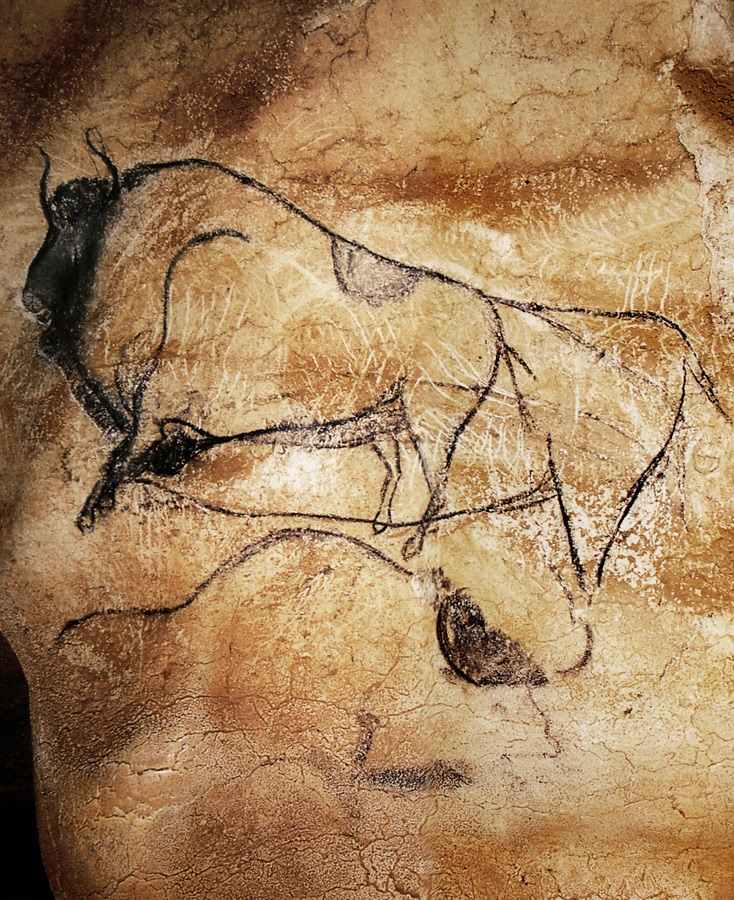
Chauvet Cave


Today I decided to talk about the paintings of Chauvet Cave.  These paintings are estimated to be about 30,000 years old and are among the oldest known art, and were the subject of Werner Herzog's documentary Cave of Forgotten Dreams.  Like many cave paintings, most of the images are of animals, but the cave also contains the oldest known painting of human representation, a pair of legs of a Venus figure (the second image).  The examples I chose are just a few of the scenes depicted on the walls of this cave system.  First we can see a pair of rhinoceros, in one of which we can actually see movement portrayed by all those extra lines that seem to be echoes of the animal.  Next there is an exquisitely rendered bison, then the pair of legs I mentioned that seem to be attached to a bull head.  The fourth image is a large group of lions and bears, then a group of horses with another pair rhinoceros facing (or perhaps fighting) each other and a pair of aurochs on the left.  We cannot say whether these paintings served a ritual purpose, perhaps intended to ensure successful hunts, or simply depicted things the artists saw.  Maybe they were for expression, the same way art has been for thousands of years since.  Whatever the intention, it is clear that visual art plays a deep, crucial role in our lives and our psyches.  These paintings, and others as well as early sculpture, far predate any written art of records.  The ability to create images to express what we see, think, and feel, is a central human endeavor, that has been with us since the earliest days of our species.


Saturday, September 6, 2014

Hiroshige, Fishing Boats on a Lake

Hiroshige, Fishing Boats on a Lake, 1834

Ando Hiroshige (1797-1858) is one of the best known Japanese printmakers, along with Hokusai (known for his Thirty-six Views of Mount Fuji).  Both artists worked in the ukiyo-e woodblock style, and Hiroshige is considered its last great master.  Ukiyo-e was popular during the Edo period and usually depicted scenes of middle class entertainment, as well as history and folklore.  It was Hokusai and Hiroshige who established the landscape print as a major theme of Ukiyo-e.  These artists had a great influence on French Impressionists, particularly Monet and Van Gogh, and we can especially see that influence in this image.  I am struck by many things in this print.  Certainly there is an amazing delicacy of line, which we might expect from Japanese prints, but the movement of the waves and the rippling of the sunset are especially remarkable.  The simplicity and richness of the color add a lot to the piece.  The variation in the water and the gradient in the sky give a realism to the scene.  The shapes of the birds, boats, clouds, and mountains all balance each other perfectly.  All of these elements result in a scene of quiet yet intense beauty.

Friday, September 5, 2014

C. Maxwell Morris, CC124

Maxwell Morris, CC124, 2013 (?)

Today's piece is by a contemporary artist named C. Maxwell Morris (also seems to go by just Maxwell Morris).  He was born in 1989 (which makes him my age, actually) and attended the University of North Texas.  I don't remember how I first came across this image, but it was featured in his BFA show.  There isn't very much information on him, but from what I can gather, these works were created by pressing glass onto painted canvases.  I just love this painting.  I read something that compared it to psychedelic paper marbling, which it certainly resembles.  It also looks like actually marble, and also cake batter, and clearly owes something to abstract expressionism.  The colors are so vivid and the shapes so interesting.

Edit: I looked at Morris's work a bit more and decided I wanted to post one of his digital paintings as well.  I'm not sure exactly what techniqure he uses to create these pieces, but I think they're amazing.


Here's his website if anyone is interested in this up and coming artist:
http://www.maxwell-morris.com/

Thursday, September 4, 2014

Andrea Mantegna, Adoration of the Shepherds

Andrea Mantegna, Adoration of the Shepherds, c1450

Andrea Mantegna (c1431-1506) was one of the great painters of the Italian Renaissance, and this painting in particular expresses the ideas of its time.  Adoration of the Shepherds is an exploration of the dissonance and harmony among different aspects of human experience.  Mantegna depicts the natural world, the material world, and the spiritual world, and manages to unite these elements visually to represent their harmony under Christ.  Each realm has its own section of the canvas: Mary and Jesus represent the divine, Joseph and the barn to the left represent the material, while on the right the natural world is presented by the landscape in the background and the two shepherds who come to worship Christ.  In this painting, Mantegna also imports aspects of the Northern Renaissance (particularly the background landscape) into his Italian style, and I also find his use of color quite striking.

Note: This description is a paraphrased excerpt from a paper I wrote a few years ago about this painting.  If anyone is interested in a more detailed analysis, just send me a message through the blog's contact form to the right.
 

Wednesday, September 3, 2014

Tom Thomson, Sunset

Tom Thomson, Sunset, 1915

Tom Thomson (1877-1917) was an influential Canadian artist.  Largely self-taught, Thomson worked as a graphic designer at an artistic design firm in Toronto.  Although he had been painting and drawing since childhood, it wasn't until 1912, at age thirty-five, that Thomson began to take his art seriously.  It was then that he first visited Algonquin Park in Ontario, and he was inspired to paint the spectacular scenery he saw there.  Thomson worked as a fire ranger in Algonquin Park during World War I (having been denied entry into the military) and during this time he produced hundreds of sketches and paintings of the landscape.  Sadly, Thomson drowned at 39 in Canoe Lake, Algonquin Park.  Since his death, Tom Thomson has become a painter of great influence and stature in Canada, and his death has continued to fascinate people, often claiming there was something more sinister to the story.  In my eyes, this particular painting is just magnificent.  The ecstasy conveyed by the vibrant colors almost pulses with intensity and the shapes created in the sky are quite arresting.  I love Thomson's loose brushwork which gives the piece a sense of immediacy and presence.  The artists love of the landscape can be clearly felt.