Saturday, January 31, 2015

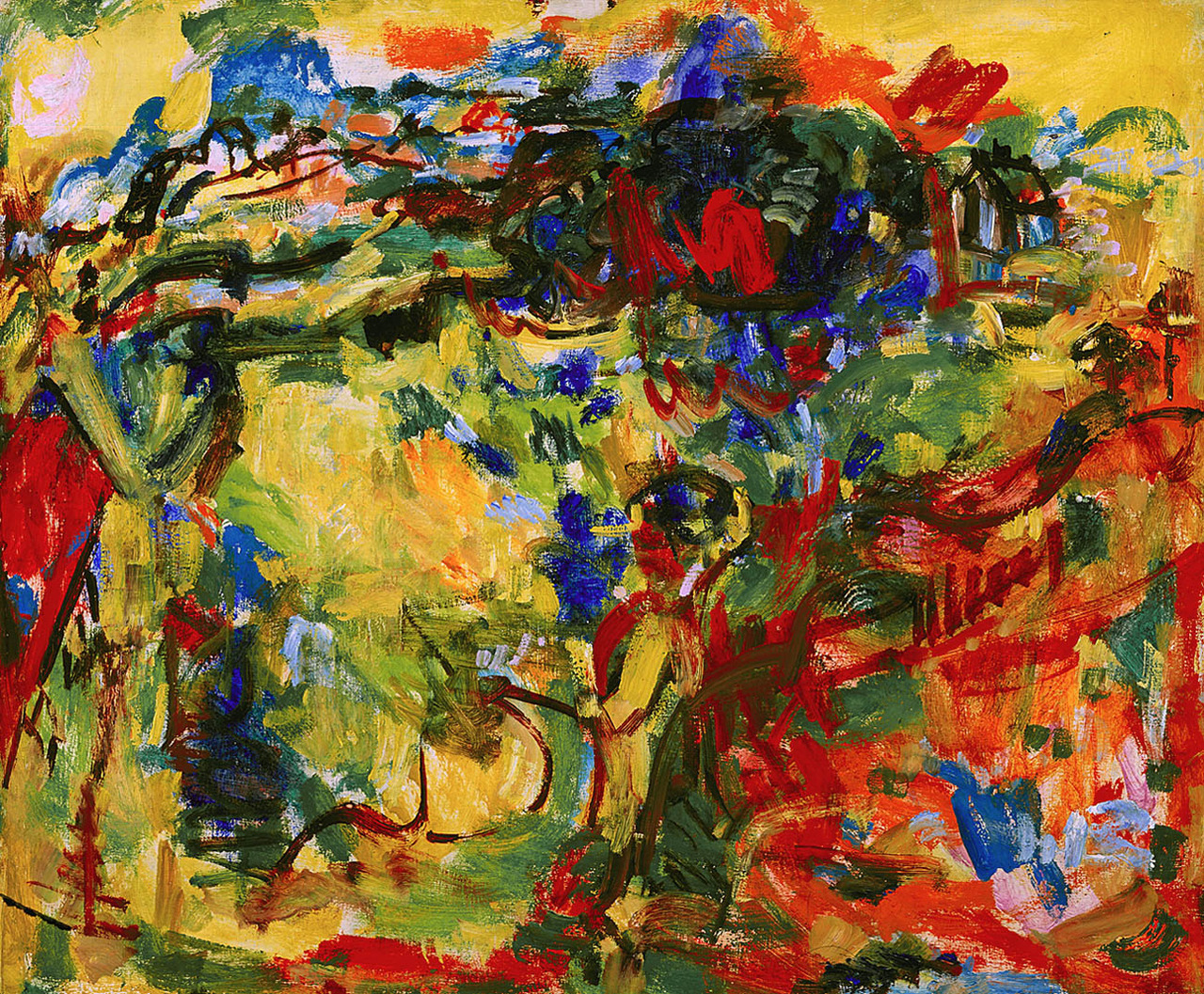
Hans Hofmann, Spring

Hans Hofmann, Spring, 1944-45
11.25 x 14.125 in.

Hans Hofmann (1880-1966) was an Abstract Expressionist painter.  Born in Germany, Hofmann first devoted himself to science and engineering; among his developments were an electromagnetic computer, a device for maritime radar, and a portable freezer.  However, Hofmann was compelled to develop his creativity and began his art education after the death of his father. He moved to the United States in 1932 and achieved great success as an artist and teacher.  His students included Lee Krasner and Helen Frankenthaler.  Even among his earlier work Hofmann's style demonstrates the great energy and intensity that would come to characterize his best known pieces.  The Gate is one such piece, and it presents a very strong contrast with Spring.  The Gate (1960) is a static work of great poise and restraint.  Its energy comes from the tension that stillness creates; all the movement is unseen and under the surface. Spring is quite the opposite. It is all movement and action.  Indeed it prefigures Jackson Pollock's famous action painting in some ways.  This painting's title gives a clear focus to the piece, putting the viewer in mind of the flash of colors from bright and the rapid buzzing of insects.  The liveliness here is quite astounding, and, although it is a rather small painting, Hofmann filled the canvas with such rich texture and vibrancy that it seems to contain an entire ecosystem.  The painting grips us with its rapid movement and the complex crossing of colors, as the white streaks fly over the green ground, and all the other colors flit around in between.  Despite the extent of abstraction, it is not difficult to discern the energy and presence of a spring day with this beautifully chaotic painting.

Friday, January 30, 2015

Carl Moll, Salon in the House on Hohen Warte

Carl Moll, Salon in the House on Hohen Warte, 1903

Carl Moll (1861-1945) was an Austrian painter who studied at the Academy of Fine Arts Vienna. Along with Gustav Klimt, he led the Vienna Secession, when modern artists split off from the Austrian academy in order to exhibit more avant-garde art.  Moll is considered a painter of art nouveau, but his style is quite diverse, ranging from somewhat Impressionist, to Expressionistic, to surrealist fantasy.  These landscapes show Moll's range and development, as his interest in well as the hidden depths of our surroundings.  In each example, we see the trees bend and twist in the fabric of the world.  Among Moll's most interesting pieces is his 1906 self-portrait; he portrays himself at work while surrounded by works of other artists (including a Van Gogh on the upper left).  Salon in the House on Hohen Warte is fascinating largely due to its use of space. The vantage point is situated behind a screen, peeking furtively, almost voyeuristically, into the room beyond.  The viewer cannot enter the primary picture space, and instead must lurk on the outside and try to see in.  What Moll shows us upon entry is a visually unusual scene.  The room recedes, stretching up the steps and showing the true spatial relationship of everything in the room.  The effect is a bit unnerving, but quite engaging.  Moll enhances the technique immensely with that rich azure blue.  The color draws the eye so that we take in the entire room, and gives the background much more visual prominence than is common.  In the foreground (well middleground if we consider the screen), the two figures are quite small and the woman's face is even cut off by the screen, but they are important for drawing the composition together.  They provide a narrative focal point, and would usually be the center of visual attention, but Moll shuns that expectation. He even gives the richly textured chairs more prominence.  With all of this in mind, the painting becomes an exploration of the nature of space, the relationship of subject and painter, as well as some very bold interior design.

Thursday, January 29, 2015

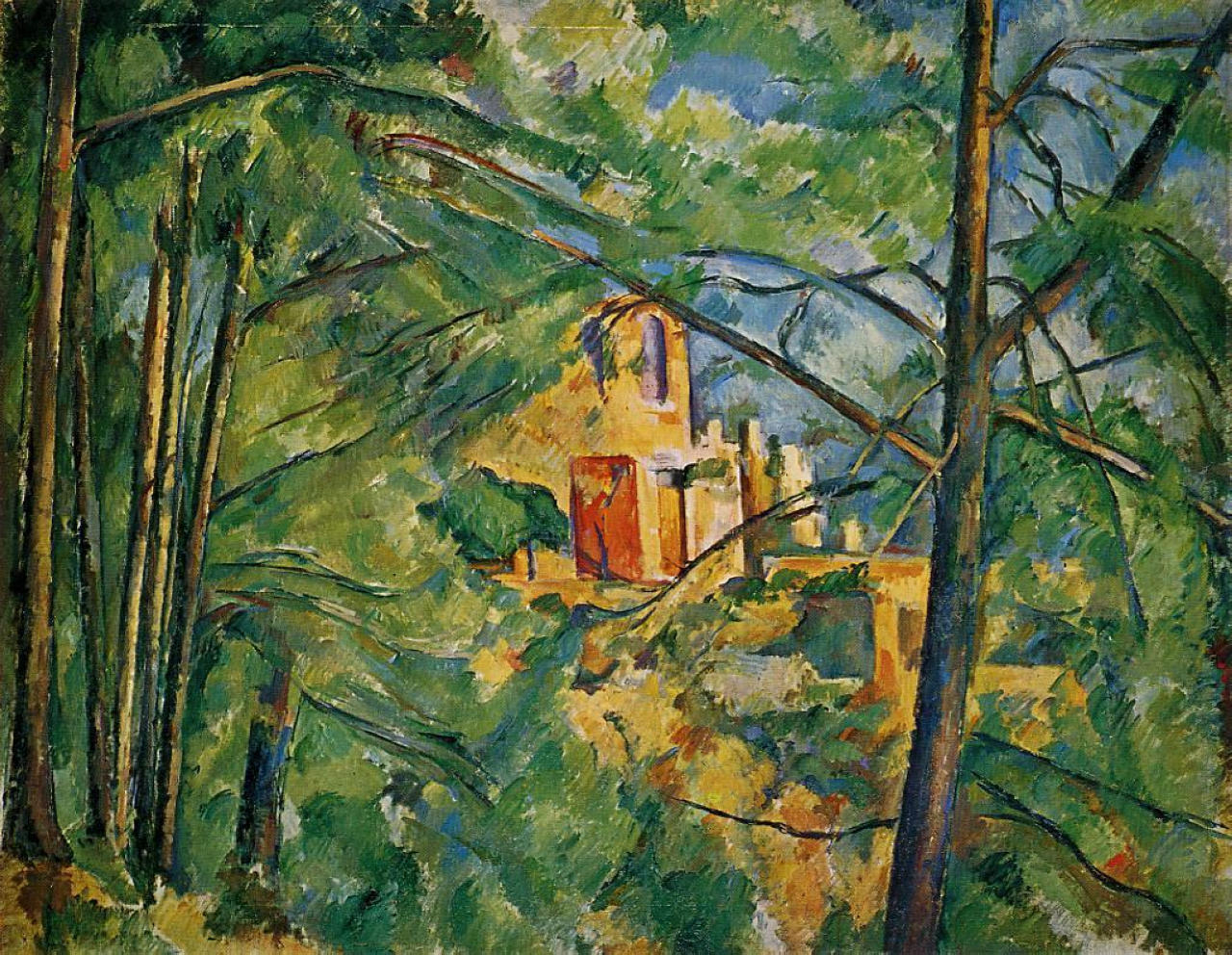
Paul Cezanne, Chateau Noir

Paul Cezanne, Chateau Noir, c1904

Paul Cezanne (1839-1906) is one of the most prominent painters of the late 19th century.  He was the first painter to deconstruct the visual elements of his subjects, leading directly to Cubism and Modernism.  Picasso called him "the father of us all."  Cezanne used small brushstrokes and large swaths of color to build his forms, creating portrayals that are simultaneously soft and angular.  Among his most famous subjects are his numerous still-lifes, particularly of apples.  He also painted numerous portraits.  I chose to write about Chateau Noir because it grabbed my attention and wouldn't let go.  Cezanne painted several views of the Chateau Noir around this time. Like many of his late paintings, they are darker and less airy than his earlier landscapes, especially true of this piece.  Instead of an open view of the subject, the trees occlude the house. The colors themselves are darker, and there is an unease at play here.  The sky is not a pale, sunny blue, but purpled and heavy.  The tree branches are angular and jagged, almost threatening. While the forms are rendered in a similar manner to Cezanne's earlier works, the indistinct character is no longer soft and warm, but hazy and foreboding.  Although I am emphasizing the menacing aspects of the painting, there is also a pure beauty here that has nothing to do with the dark tonality of the work.  Cezanne's skill is remarkable and his ability to communicate a fully realized vision of his subject is endlessly engaging.  This is a deep meditation on the chateau, and perhaps on Cezanne's feelings about nature and his surroundings in general.  The intensity of feeling that infuses every masterful brushstroke is what truly holds our gaze.

Wednesday, January 28, 2015

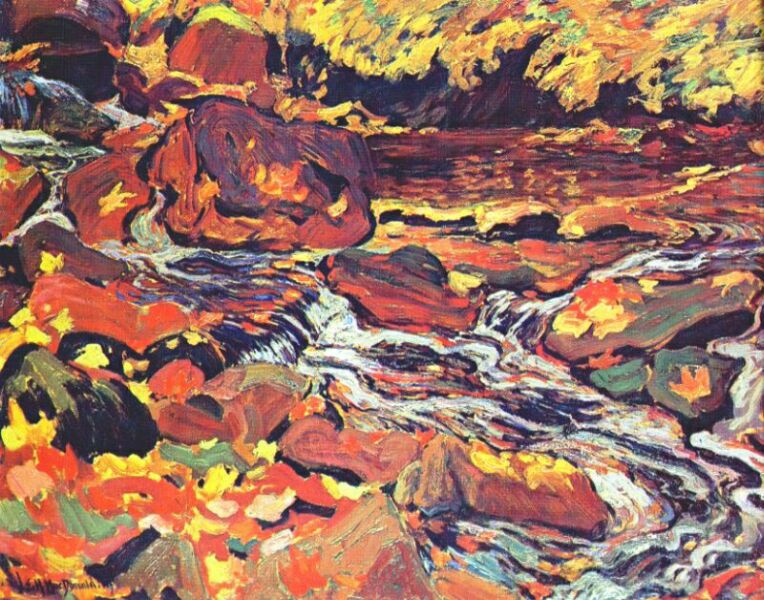
J.E.H. MacDonald, Leaves in the Brook

J.E.H. MacDonald, Leaves in the Brook, 1919

James Edward Harvey MacDonald (1873-1932) was a Canadian painter and a founder of the Group of Seven, who helped launch the first major Canadian national art movement.  MacDonald was born in England and moved to Canada with his English mother and Canadian father, a cabinetmaker.  It was that year, at age fourteen, that young James began his first formal art training at the Hamilton School of Art in Ontario.  After attending the Central Ontario School of Art and Design, MacDonald began working as a commercial designer.  He quite his job in 1911 and moved with his wife and son to a more rural area of Ontario so that he could begin work in earnest as a landscape artist.  Some of his early work resembles Impressionism, but he soon shows the influence of Expressionism.  Throughout his career MacDonald continued to utilize different styles and explore the breadth of the Canadian landscape.  Rather than a vast panoramic view, Leaves in the Brook is small, closeup examination of a natural element.  This painting shows the vibrant beauty of autumn as the leaves blanket, not just the brook, but the ground.  They seem to color everything, radiating their warm colors and turning even the rocks red and orange.  They flit through the brook or float on the surface like so many fish in the water. The brook itself is deep blue and purple, where it isn't white with movement, coursing through this forest scene. MacDonald's loose brushwork and flowing lines perfectly communicate the swirling waters, and the crisp autumn breeze that blows the leaves into the small current.

Tuesday, January 27, 2015

Jankel Adler, No Man's Land


Jankel Adler, No Man's Land, 1943

Today is Holocaust Remembrance Day and the 70th anniversary of the liberation of Auschwitz. As such, I chose to write about Jewish-Polish artist Jankel Adler (1895-1949).  Adler was born in Lodz, Poland as one of ten children.  He began his artistic training as an engraver with his uncle. When he moved to Germany in 1914, he began formal training as an artist.  Adler experienced his first success when he moved to Dusseldorf to teach at the Academy of Arts there and was soon awarded a gold medal at a major exhibition.  During the 1932 German elections, Adler campaigned actively against the National Socialists and for communism.  When the Nazi regime took power, Adler left Germany for Paris.  Two of Adler's paintings were included in Hitler's 1933 show of degenerate art, and four more were included in the 1937 iteration.  Adler considered his exile an act of political resistance and spent the following years traveling Europe and speaking against fascism, until the war actually broke our.  In 1939 he volunteered for the Polish army that had been reconstituted in Paris, but was discharged two years later for health reasons.  Adler painted in a style that mixed Cubism and Expressionism, with a touch of Surrealism.  Despite his political engagement, Adler's work features little direct reference to the war or the political climate in Europe.  Instead, Adler's paintings explore the human body and our relationship to our surroundings.  One painting that does address the war is The Mutilated, which shows wounded soldiers and the hardships of their amputated lives.  No Man's Land is a complex entry in the discussion of Adler's life and work.  Ostensibly, the painting is based on an experienced he had walking through fields on a warm evening, when he saw a bird singing all alone.  Certainly we can discern this scene in the painting, with a lone bird singing to the moon, but it is difficult to ignore the symbolism in this work by a persecuted Jewish artist.  With its dark coloration and ominous title, the bird seems to be singing in a landscape of death.  Perhaps Adler himself felt like the bird singing to an empty space, unheard by everyone.  Whether intentionally or not, this painting is suffused with great sadness, suffering, and depth of feeling.  We can sense the painter's intense pain at the state of Europe.  Adler died in 1949 with the knowledge that none of his nine brothers and sisters survived the Holocaust.

Monday, January 26, 2015

Blizzard in New York

I know a lot of my readers are in the New York area and enduring this blizzard.
Stay warm and safe everyone.

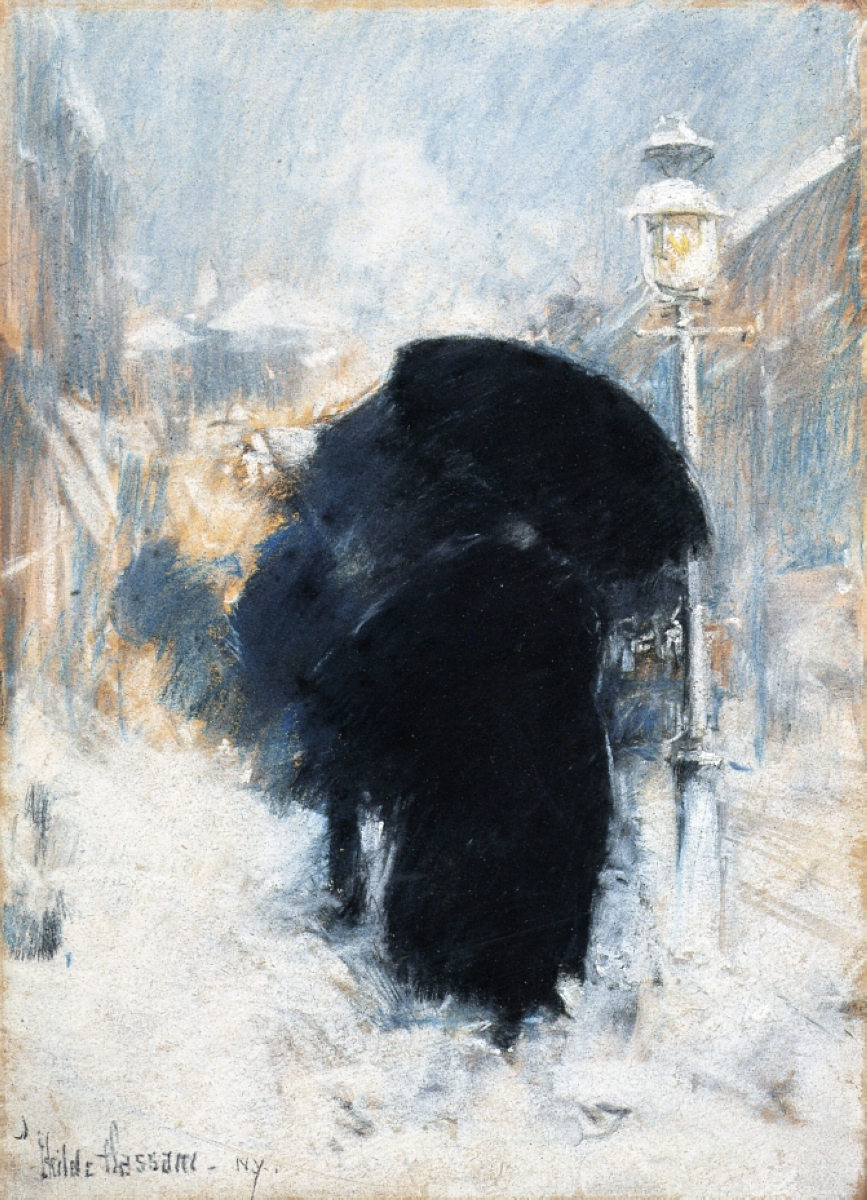
Childe Hassam, A New York Blizzard, 1890 

James Abbott McNeil Whistler, Nocturne in Gray and Gold: Chelsea Snow, 1876

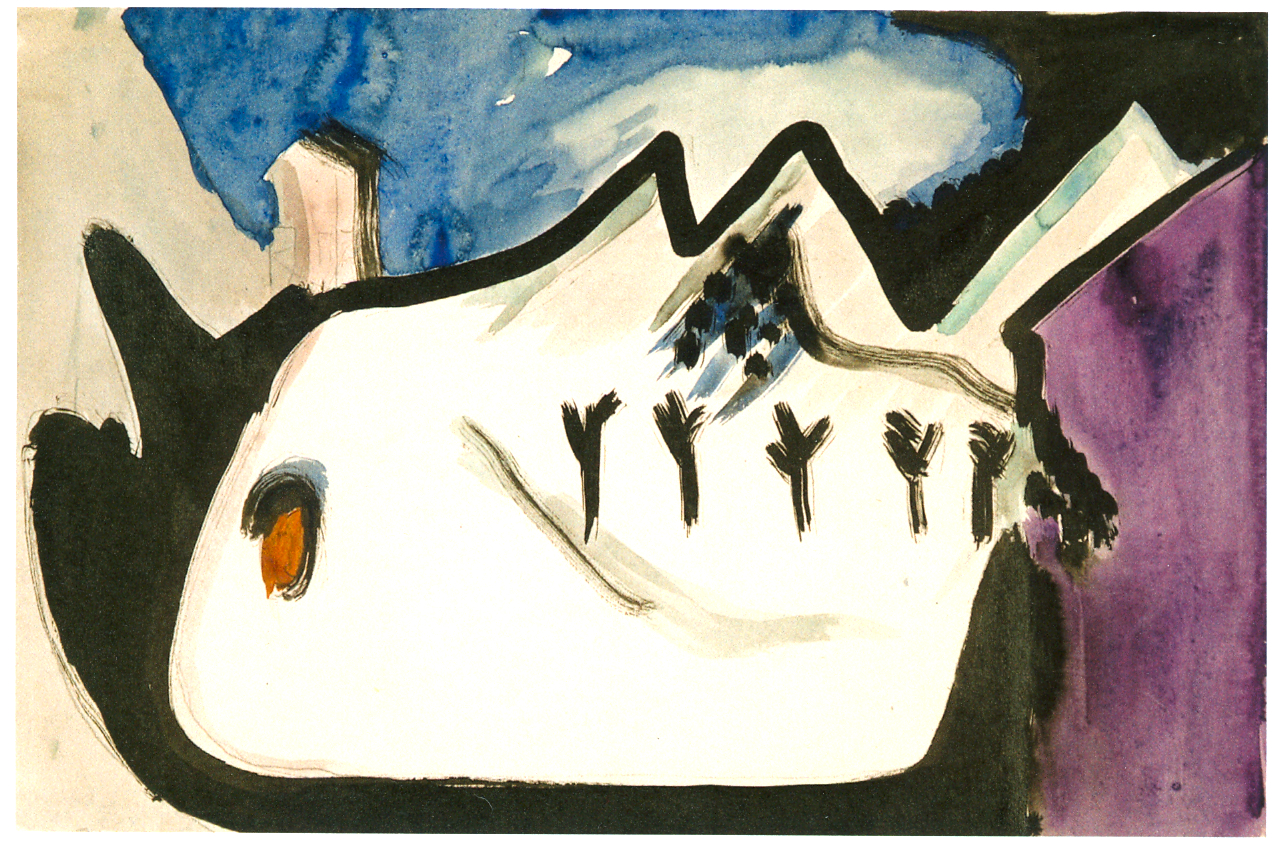
Ernst Ludwig Kirchner, Snowy Landscape, 1930

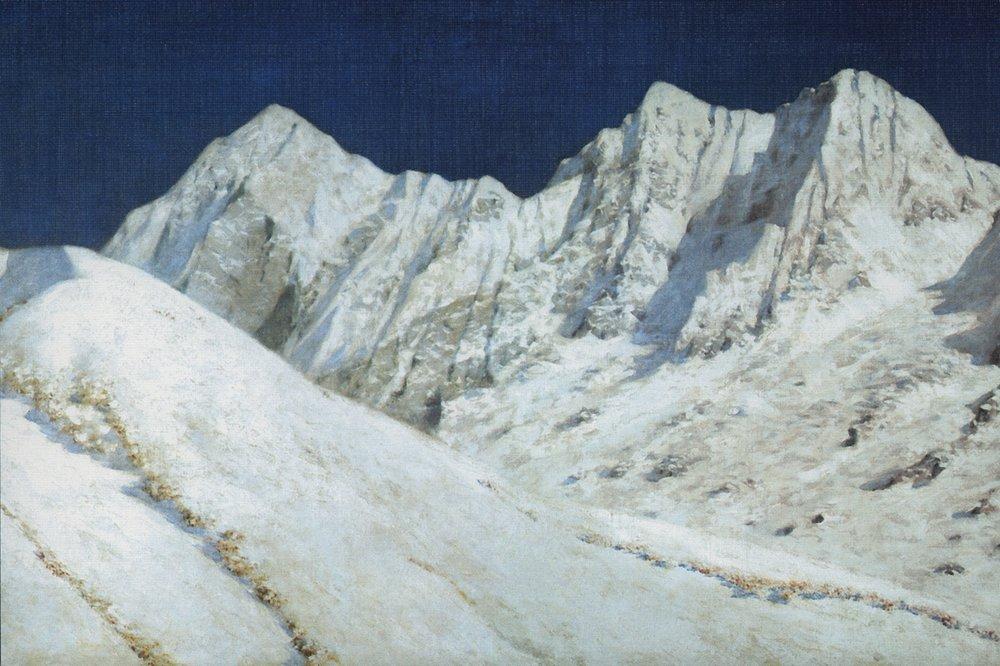
Vasily Vereschagin, In India, The Himalayan Snow, 1874

Konstantin Yuon, The Blue Winter Day, 1915

Edvard Munch, Winter, Kragero, 1912

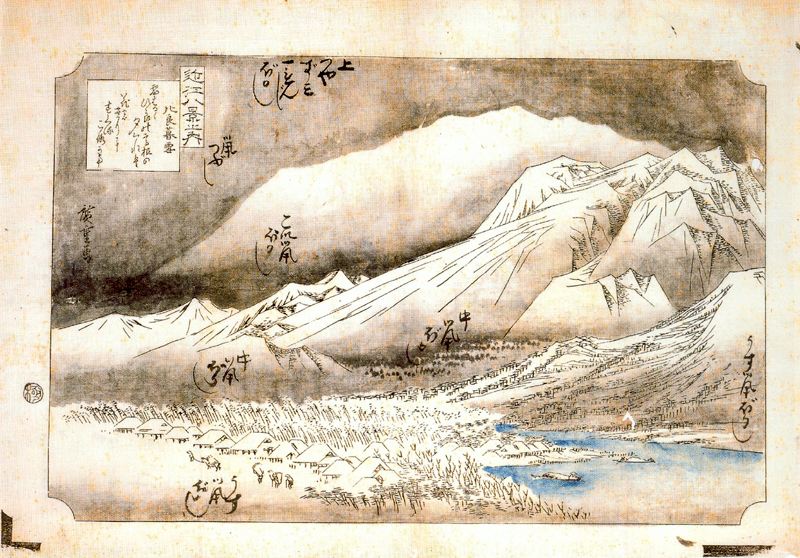
Hiroshige, Evening Snow on Mount Hira, 1859

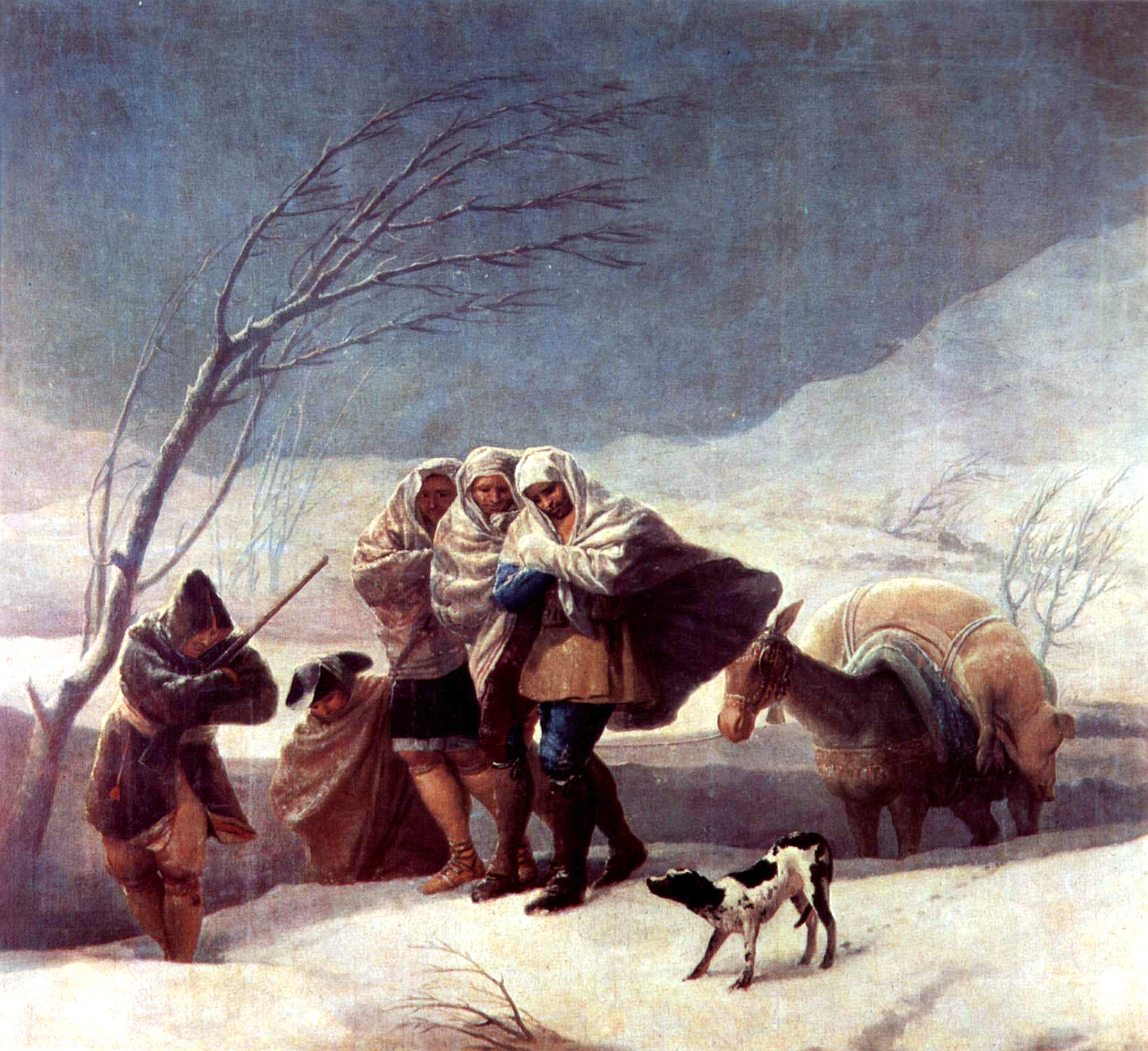
Francisco Goya, The Snowstorm (Winter), 1787

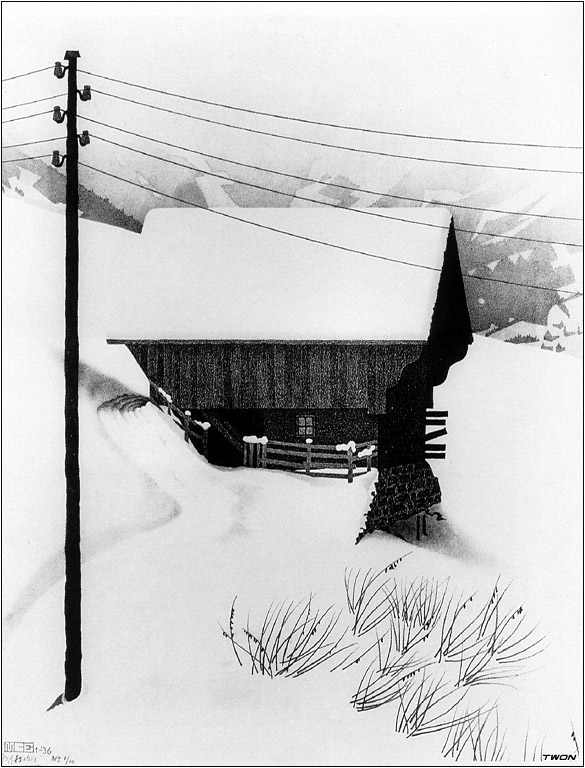
M.C. Escher, Snow, 1936

Marilyn Cvitanic, After the Blizzard, 2014

Elena Maza, After the Blizzard, 2010

Claude Monet, The Magpie, 1869

Sunday, January 25, 2015

Stanislaw Witkiewicz, Sunset at Sea

Stanislaw Witkiewicz, Sunset at Sea, 1887

I have posted a lot of seascapes and a lot of sunsets on this blog, and several that are both, but they continue to engage and amaze me.  Today's selection is another fine example of the genre. Stanislaw Witkiewicz (1851-1915) was a Polish painter, as well as an architect, writer, and theorist of art and philosophy.  Witkiewicz was born in a village in the Polish-Lithuanian Commonwealth, but now sits in Lithuania, and attended school in St. Petersburg and Munich. However, he came to oppose formal education, writing that "school is completely at odds with the psychological makeup of human beings." He became a leading member of the Warsaw Positivists.  Much of his art fits firmly into Realism, but some of his landscapes have a more Romantic tone in their explorations of nature.  Sunset at Sea exhibits elements of both styles, but tends more toward Realism.  We see this fisherman rowing his boat, presumably heading back to shore for the night.  Although he is small himself, his outstretched oars span most of the canvas and his red scarf marks him prominently.  The glassy water is portrayed quite skillfully, while two other boats appear in the distance.  In the middle ground is another rowboat, perhaps another pair of fishermen or laborers, but in the far background is a steamship.  It is tiny, but its influence is palpable.  The black smoke cuts across the sky, disrupting the sunset and upsetting the tranquil scene.  This represents the industry that was overtaking these fishermen with their rowboats. Nevertheless, the sunset is quite beautiful.  It is a simpler sunset than some of the others I've written about, merely the deep orange orb against a pale and fading sky.  The deftness of Witkiewicz's use of color in the sky is remarkable, for he evokes the sunset with very few colors, but shaped and shaded to perfectly reflect evening sky.