Saturday, February 28, 2015

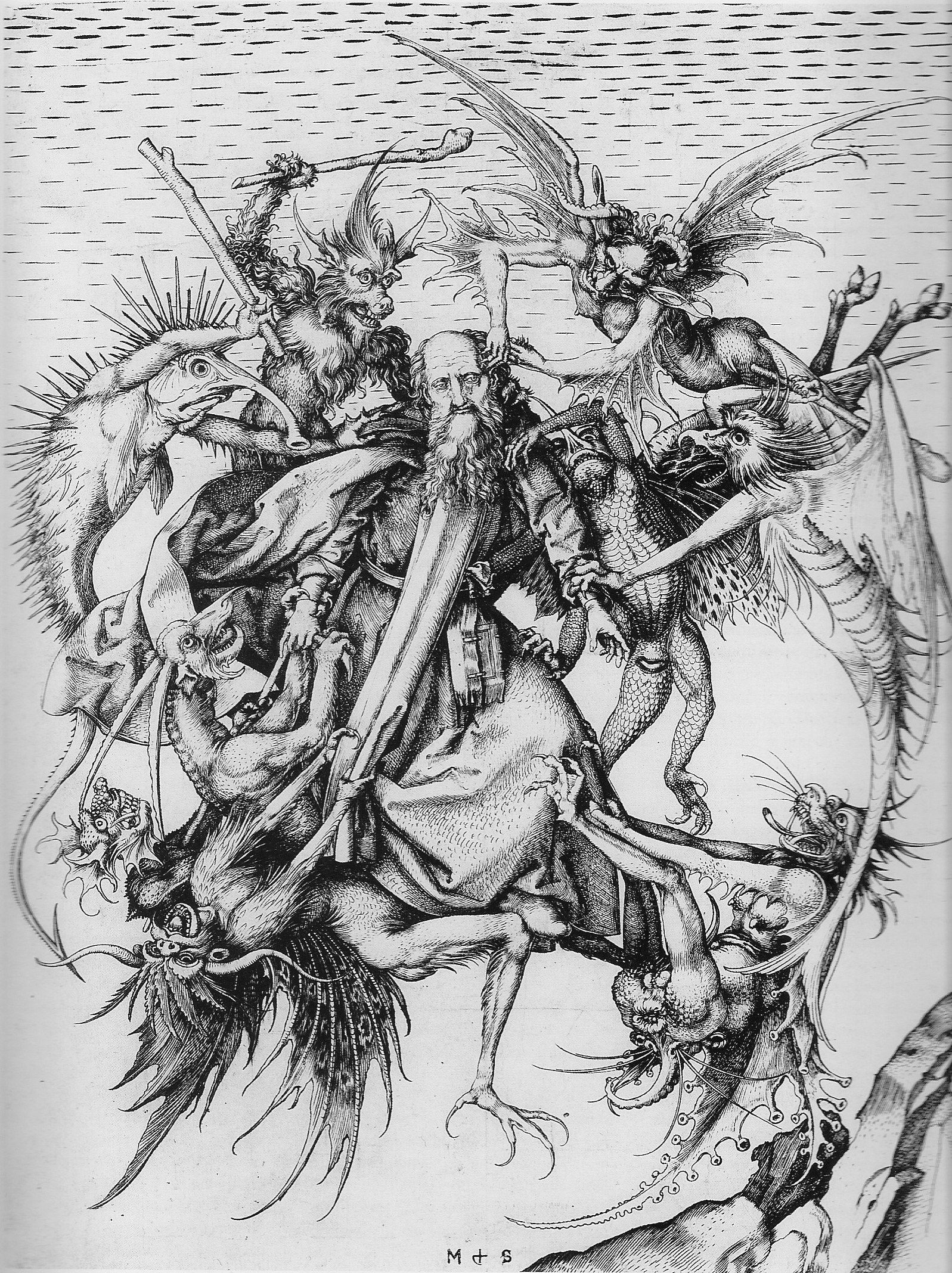
Michelangelo, The Torment of St. Anthony

Michelangelo, The Torment of St. Anthony, 1487-88
18.5 x 13.25 in.

Michelangelo (1475-1564) is of course one of the most celebrated figures in the history of art.  His contributions to painting, sculpture, and architecture are immeasurable and he created some of the most prevalent artistic images in our culture.  He was also a skilled poet and engineer.  Born Michelangelo di Ludovico Buonarotti Simoni, he was considered the greatest living artist during his lifetime and was the first Western artist to have a biography published during his lifetime.  His influence on art and Renaissance culture is perhaps greater than any other figure of the period. The Torment of St. Anthony is Michelangelo's earliest known painting, done when he was twelve or thirteen years old.  The painting is after an engraving by the German printmaker Martin Schongauer.  Until recently, the painting was attributed to the studio of Domenico Ghirlandaio, to whom Michelangelo was apprenticed at the time.  It was decided in 2009, after close examination, that the panel was indeed a Michelangelo.  The trials of St. Anthony were a popular subject at the time, showing the saint besieged by devils but resisting their temptations.  This painting differs significantly from most of Michelangelo's work, being based on the late Gothic style of Schongauer, but already we can see the skill of a master emerging.  There is great detail and texture in the rendering of the demons' faces and bodies, great tension in their moving limbs and contorting forms.  Anthony's face shows great passion and emotion, with each hair in his beard carefully executed.  The landscape at the bottom of the scene also holds great interest; though presented rather roughly, the water and trees effectively communicate their presence and movement.  Michelangelo's depiction of the rocks is also fascinating, presented realistically with rough and sharp surfaces, yet they also have a certain softness in their molding that creates a deep beauty.  With intense colors and somewhat sculptural forms, this painting contains some elements that herald the artist's later work, but it also offers a glimpse into this young genius, when he copied the popular German engraver and was beginning to master his craft.

This is my 200th post, so I would like to thank all of my readers. I hope you continue to enjoy my blog.

Friday, February 27, 2015

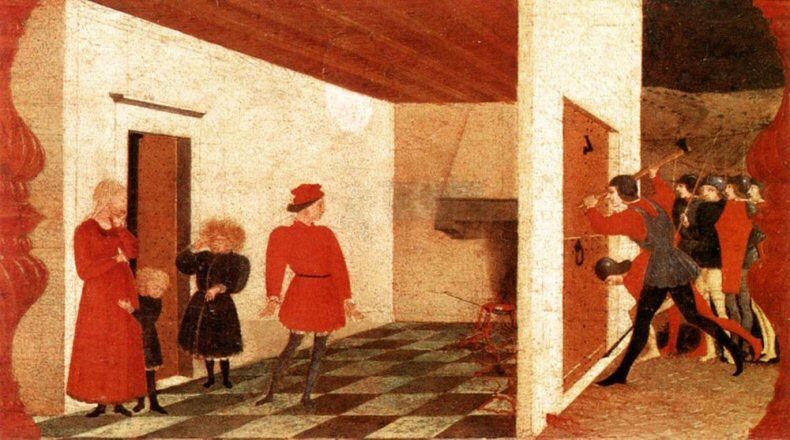
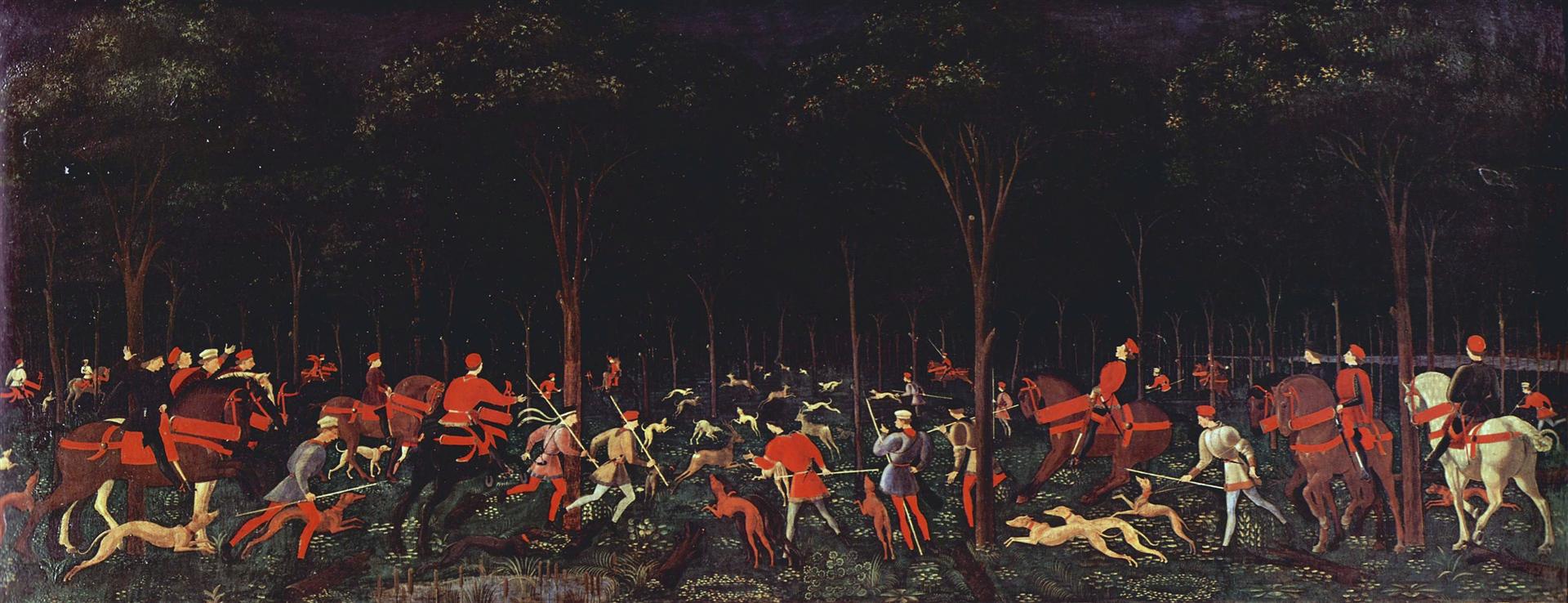
Paolo Uccello, The Hunt in the Forest

Paolo Uccello, The Hunt in the Forest, c1470
26 x 65 in.

Paolo Uccello (1397-1475) was an Italian painter, as well as a mathematician, and a major figure in the Italian Renaissance.  He is known for his innovative use of perspective and depth to illustrate narratives.  Born in Pratovecchio, Tuscany as Paolo di Dono, his father was a barber-surgeon and his mother was a high-born Florentine.  His nickname of Uccello was due to his fondness for painting birds.  At age ten he was apprenticed to the sculptor Lorenzo Ghiberti, whose workshop was the center of Florentine art in the early fifteenth century.  Ghiberti's work had a great influence on Uccello and he remained with the master until about 1420.  At some point during his apprenticeship Uccello formed a lifelong friendship with Donatello.  Uccello became a member of the painters' guild and was a respected member of the developing art world in Florence. Uccello's best known work is the famous triptych of The Battle of San Romano (1, 2, 3).  Painted between 1435 and 1460, the three panels show extremely advanced understanding of perspective and depth, communicating the recession of space and the overlap of figures and objects. Elements like the crossing of spears and horses' legs, dense crowds, and clearly delineated foreground, middleground, and background all demonstrate Uccello's skill and vision.  Such techniques were incredibly advanced at the time.  We can see the same explorations in other celebrated works by Uccello.  The Hunt in the Forest is one of Uccello's later works and we can see a mature expression of these techniques.  The scene is densely populated, but each element is placed carefully in the composition.  The piece has a clear shape, with horses grouped on the edges and a triangular group of dogs that extends into the forest. The painting has a remarkable expression of the recession of space; the dogs recede into the darkness, the point of their phalanx lining up with the painting's vanishing point.  The overlap of objects gives Uccello's work an unprecedented realism, as people and animals cross both in front of and behind the trees.  Uccello favored bright colors throughout his work, and here the bright reds stand out powerfully against the dark greens and blacks of the forest.  While Uccello left behind no school of students or followers, the influence of his work has been vast and he continues to exert a powerful impact over artists and viewers today.

Thursday, February 26, 2015

William Breakspeare, Nude at a Table

William Breakspeare, Nude at a Table
7.25 x 10.5 in.

William Breakspeare (1855-1914) was an English artist from Birmingham.  His father was a flower painter in the japanning business (a type of lacquer finishing used on furniture and decorative items) and Breakspeare was himself apprenticed to japanners.  He transitioned into painting and became involved with the Royal Birmingham Society of Artists, to which he was elected as a full member in 1884.  He spent time in Paris, beginning in 1879, and moved to London in 1881, often exhibiting at the Royal Academy.  Breakspeare's work shows a wide range of influence, including the Pre-Raphaelites and Orientalism, but he also worked in more traditional modes of portraiture and genre painting.  Breakspeare seems to repeatedly find interest in painting women in traditional role of female beauty and sexuality, but showing their vulnerability and sometimes discomfort, thus calling into question the meaning of this style of art. We can see this in The Reluctant Pianist and The Mermaid, and even his take on Venus.  This theme is certainly quite present in Nude at a Table, in fact it dominates the painting.  This girl appears quite young and uncertain, even uncomfortable.  Breakspeare does not shy away from that discomfort, but embraces it and portrays it effectively, creating a powerful and engaging painting.  In terms of technique, this piece is successful because of Breakspeare's smooth brushwork that appears consistent throughout the painting.  His strokes are molded and deliberate, but also gentle and relaxed.  From the rough background, to the carefully shaped objects on the table, the drapery of the cloth, and the smooth rendering of the girl's body, Breakspeare's hand is even and effective. The girl's face is rendered beautifully and with intense emotion.  With her small features and sympathetic eyes, Breakspeare makes us feel great sympathy for this young model.  The girl's pose tells us a great deal about her feelings; her body is turned away and largely hidden from view, with only her head turned toward the painter.  Her hands are raised as though she wants to hide her face in them, and has only turned so that we may see her anguish.  This approach calls into question the relationship of female subject to the male painter (and viewer).  If this model was so uncomfortable with posing nude, is it right that Breakspeare ask this of her and subject her to the male gaze?  Perhaps the girl's anguish is posed by Breakspeare as well, intended to make a point about the nature of the male gaze in the history of painting.  While we may never know the truth of this situation, the beautiful painting raises these important questions and prompts us to reconsider the subjectivity of this nameless model.

Wednesday, February 25, 2015

Sam Francis, Middle Blue No. 5

Sam Francis, Middle Blue No. 5, 1959-60

Sam Francis (1923-1994) was an American painter and printmaker whose works primarily interpret the role of color in bold and complex ways.  Although sometimes associated with the second generation of Abstract Expressionists, such as Helen Frankenthaler and Joan Mitchell, Francis was never a member of the group.  Unlike those artists, who worked out of New York, Francis spent most of the 1950s in Paris.  Born in San Mateo, California, Francis joined the Air Force.  He was in hospital in California for several years, where he began to paint after being visited by the painter David Park.  After the war, he attended UC Berkley, where he studied botany, medicine, psychology, and art.  Francis had his first exhibition in Paris, but soon was exhibited internationally, including MoMA and the Kunsthalle Basel.  Francis's work explores color in a variety of styles and contexts, including works that resemble color field and others that resemble dense webs of color.  Many of his works simultaneously resemble geometric and natural forms. Middle Blue No. 5 demonstrates many characters and elements of Francis's work. The large gathering of paint that dominates the painting certainly draws the eye and we can see the complicated ways that Francis fit these many smaller patches of color together.  Sometimes he places patches of the same color together but often he separates them with another color. Each patch of color seems to radiate outward with the streaks and splatters that cross each other and stretch across the canvas.  In this piece, Francis shows us each color in isolation and interacting with all the others.  It is a masterful expression of shape and color from one of the great abstract artists of the century.

Tuesday, February 24, 2015

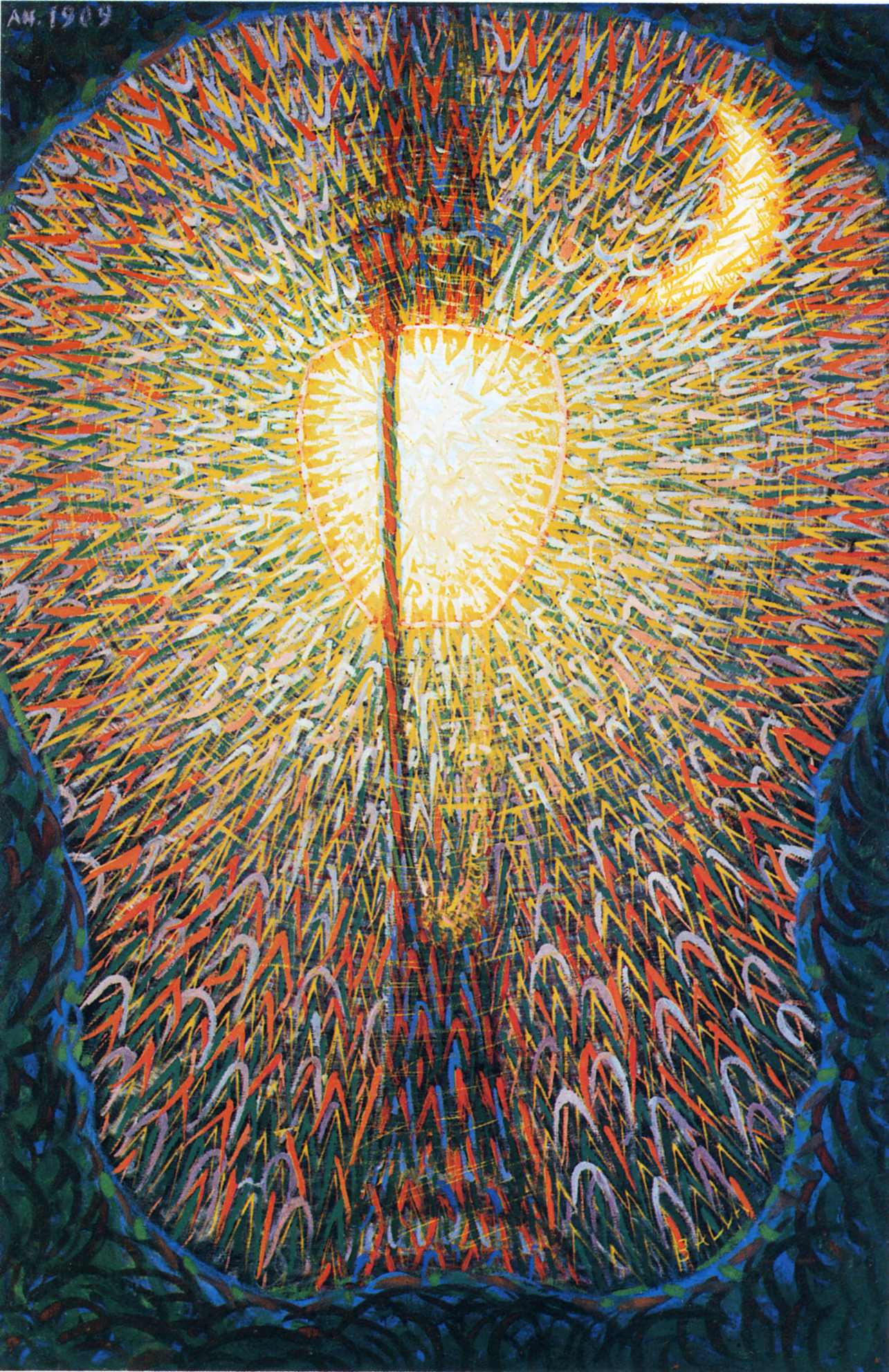
Giacomo Balla, Street Light

Giacomo Balla, Street Light, 1909
68.78 x 45.16 in.

Giacomo Balla (1871-1958) was an Italian Futurist painter and a prominent art teacher.  Born in Turin to a photographer and a musician, Balla began his art career working in a lithograph print shop.  He attended the University of Turin and had some early success there before moving to Rome in 1895.  In Rome Balla worked as an illustrator and caricaturist.  In the following years, he showed at several major exhibitions in Rome and Venice, including the Venice Biennale, and also had international success.  Balla began teaching and counted prominent artists such as Umberto Boccioni and Gino Severini among his students.  Balla began experimenting with Futurism and was a signatory to the Futurist Manifesto in 1910.  He began designing Futurist furniture, extending the movement beyond the canvas.  Unlike most Futurists, Balla was not concerned with modern machines or violence, and instead his painting is known for his visual representations of light, speed, and movement.  1914's Abstract Speed and Sound is among his best known pieces. Street Light is a powerful example of Balla's style, exemplifying his visual representations of light. In this piece, Balla juxtaposes the artificial light of the lamp with the moon that is visible through the glow.  With his unusual brushstrokes, composed mostly of small and precise lines, and the bright palette, this large piece makes quite an impression.  Balla's take on the luminous scene is intense and beautiful, while also somewhat off-putting and eerie.  I had a brief blackout in my house tonight so I am particularly glad of Balla's illumination.

Monday, February 23, 2015

Curt Butler, Shallows

Curt Butler, Shallows

Curt Butler is a contemporary artist who works out of North Carolina.  He attended Kent State University and the Savannah College of Art and Design.  Some of Butler's work is figurative, mostly landscapes and nature scenes, but a lot of his work exhibits a more tenuous relationship between the appearance of the subject and the appearance of the painting.  To me, this work is significantly more effective.  Butler's work is not abstract, for the figurative subject remains visible, but the scene appears veiled and distorted.  Butler achieves this effect through the use of mixed media, specifically oil and encaustic.  Encaustic means the application of hot wax mixed with the pigments, and in Butler's case he also scrapes away some of the wax with a palette knife.  This is what gives his pieces that worked over appearance, and the fractured space that significantly contributes to the visual interest of his work.  Shallows is perhaps Butler's most successful piece. It presents its subject of lake and surroundings, but offers significantly more. The piece might first appear abstract, but as the subject emerges, we see a complex relationship between space, color, and paint.  The scene appears through a grimy window or hazy veil.  The scene appears to be melting, as the paints blend and change in contact with the wax.

Sunday, February 22, 2015

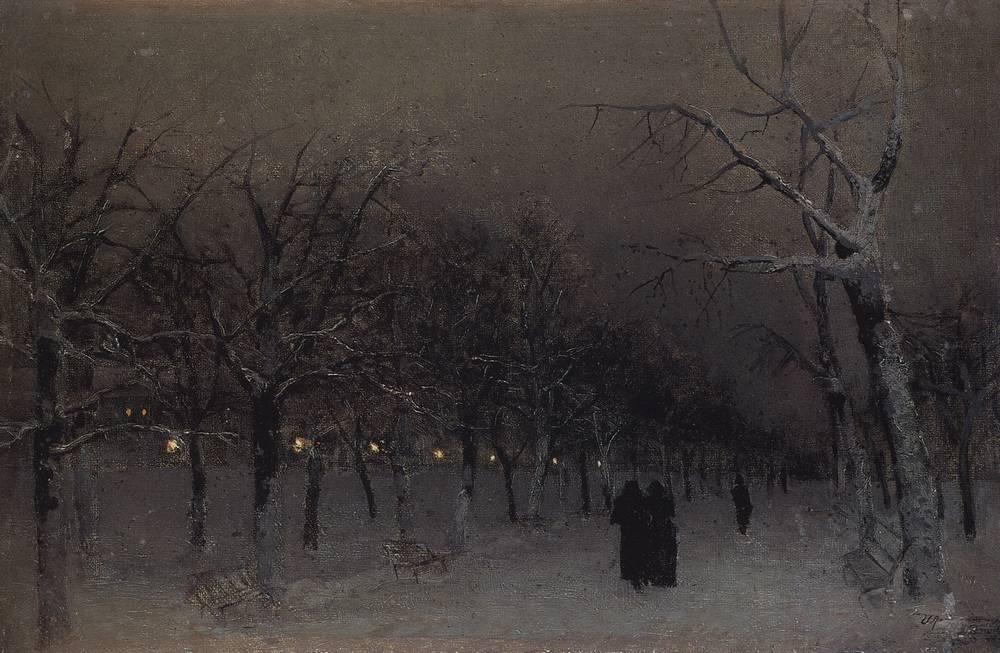
Isaac Levitan, Boulevard in the Evening

Isaac Levitan, Boulevard in the Evening, 1887

Isaac Levitan (1860-1900) was a Russian landscape painter known for his atmospheric depictions of the Russian countryside, particularly the area around Moscow.  The style he came to be associated with is known as mood landscape.  Levitan was born in present day Lithuania to a poor, well-educated Jewish family.  He attended the Moscow School of Painting, Sculpture, and Architecture where he tried  his hand at multiple genres before he transferred into the landscape class.  Levitan had his first public exhibition at age seventeen and was very well-received.  In 1879, mass deportations of Jewish families from major Russian cities forced Levitan and his family to relocate to the suburb of Saltykovka, but pressure from the art world allowed the family to return to Moscow.  Levitan continued to experience professional success and was eventually elected to the Imperial Academy of Arts and named head of the landscape studio at the Moscow School.  Boulevard in the Evening is a beautiful example of Levitan's skill and style.  This winter scene demonstrates the atmosphere he was so known for and his ability to portray a landscape in a realistic manner, while still creating a complex and powerful emotional impact.  In this piece, the white path and grey sky are joined by bare, sharp trees; they stretch over the path and recede far back, dominating the scene.  However, the people walking convey a different sense, with the energy of activity and the warmth of companionship.  Finally, the small lights that dot this stretch of trees also add a touch light and warmth that comes to characterize the whole painting, leading the way through the cold and dark.