Wednesday, April 1, 2015

Mary Cassatt, The Opera

Mary Cassatt, The Opera, 1878

Mary Cassatt (1844-1926) was a major American painter who spent much of her life in France and was a core member of the Impressionists.  She was also instrumental in increasing the interest in Impressionism in America.  Born in Pennsylvania, Cassatt first traveled to France as a child and was first exposed to French art at the Paris World's Fair in 1855, where Ingres, Delacroix, Corot, and Courbet were exhibited.  She began studying at the Pennsylvania Academy of Fine Arts in Philadelphia at age fifteen.  Frustrated with the other female students who were not interested in art as a career, and female students being prohibited from using live models, Cassatt began teaching herself.  She moved to Paris in 1866 and studied under Jean-Léon Gérôme.  Her technique progressed immensely in these years, showing great promise in her academic painting. In 1872 she was accepted to the Salon and in 1874 she opened her own studio.  However when her Salon submissions were rejected, she was invited by her friend Edgar Degas to show with the Impressionists.  Many of Cassatt's works concern themselves with the private lives of women and children.  She shows great sensitivity for the nuances of these scenes, imbuing with both gravitas and joy.  The Opera is a rather different piece.  It depicts the modern French society that Impressionists were so concerned with.  One of the most interesting things about this painting is the pose of the subject.  She is not looking toward the viewer or facing us in any way.  Instead Cassatt depicts her facing the stage, engaged in the action of the performance.  This transforms the painting into one of observation, where the artist makes us a part of the scene.  This painting is a prime example of Cassatt's skill, with the molded brushwork and excellent use of perspective creating a very successful piece.  Notice also the man in the distance who is using his opera glasses, not to watch the performance, but to gaze at this woman instead.

Tuesday, March 31, 2015

Félix Vallotton, The Red Room

Félix Vallotton, The Red Room, 1898

Félix Edouard Vallotton (1865-1925) was a Swiss/French painter and printmaker.  He was a member of the group of artists known as Les Nabis, who followed the Impressionists, and used highly stylized forms and colors to explore the emotionality of their subjects.  Born in Switzerland, Vallotton moved to Paris in 1882 to study at the Académie Julian.  He spent much of his time studying the old masters at the Louvre, and his earliest works are rather academic.  His first self-portrait received honorable mention at the Salon of 1886.  In the following decade, Vallotton developed his painting and began creating woodcut portraits of prominent figures, beginning with Paul Verlaine.  He was instrumental in the revival of the woodcut as an artistic medium.  His painting encompasses a wide variety of styles and subjects, including landscape, portraits, and genre scenes.  The Red Room is a powerful example of Vallotton's style and skill.  We see the angularity of his forms and the intensity of his colors.  The composition is incredibly potent here: the man and woman are both standing in the doorway, thus far leaving the sedate room uninterrupted.  However the tension between them is palpable, and it pervades the picture space and this sharp, vibrant room becomes taut with tension as well.  Vallotton increases this effect with stark shadows and angles.  The red of the chamber becomes the red of the couple's sexual tension.  The shadows of the doorway, meanwhile, nearly swallow the couple so that they are barely visible.  The effect suggests that they can only be fully realized by entering this bright room, and if they move in the other direction, if they retreat from their passion, they will cease to exist.

Monday, March 30, 2015

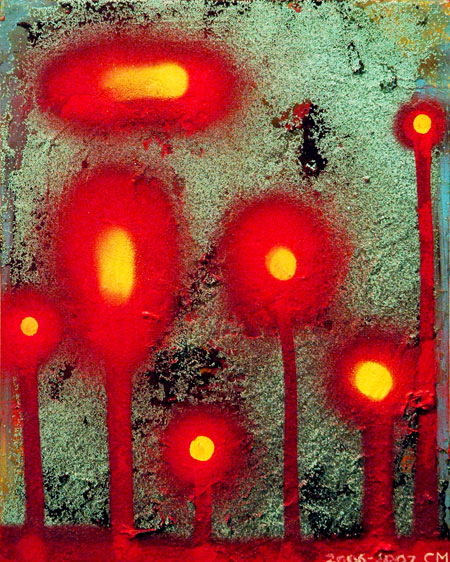
Chris Martin, Griffin

Chris Martin, Griffin, 1980

Chris Martin (b.1954) is a contemporary artist based in Brooklyn.  Martin is a very interesting painter who incorporates mixed media materials into his painting, such as refuse and foodstuffs. He has stated that these things find their way into his work after he uses them in his life, giving his paintings and organic and visceral quality.  His work is varied, and generally uses bright colors and abstract shapes to express the absurdity in society and humanity.  Many of his pieces have a luminosity, populated by balls of light, that makes his work quite engaging and bright. Griffin is an earlier work of Martin's, painted soon after he left Yale to pursue his art.  The stark contrast in colors in this painting makes it instantly arresting.  We can see a long-legged animal here, perhaps the griffin of the title, but the geometric forms in this piece are quite prominent.  The canvas is partitioned in an asymmetrical manner that makes it slightly unsettling. A conflict is created in the rich green and orange, which both clash with and complement each other.  Martin turns an animal into geometry and natural forms into bright unnatural colors.  This painting is quite effective because it communicates a deep understanding of form, color, and space.

Sunday, March 29, 2015

David Brett, Low TIde

David Brett, Low Tide, 2013

Another photograph of my own, presented without comment.

Saturday, March 28, 2015

Julian Onderdonk, Bluebonnet Landscape with Cacti, Road, and Mountain Laurel

Julian Onderdonk, Bluebonnet Landscape with Cacti, Road, and Mountain Laurel

Robert Julian Onderdonk (1882-1922) was an American painter who was very important in the advancement of an art movement in Texas.  Born in San Antonio, his father was also a painter and Julian grew up drawing and painting.  He began studying seriously as a teenager, and at age nineteen his father sent him to Long Island to study with William Merritt Chase.  Onderdonk lived in New York for a few years before moving back to Texas.  He worked mostly in landscape, and usually painted en plein air.  Much of his work has a distinct vibrancy, wherein the color of one element, such as the yellow sky, seems to tinge the coloration of the entire scene.  He is best known for his bluebonnet paintings, and he painted these flowers repeatedly and in many different scenes.  The painting I have featured is a beautiful expanse of the flowers that turns the whole painting a brilliant blue.  The color of the flowers here is somewhat brighter than in some of the other pieces, an effect that is enhanced by the sheer volume of flowers.  The composition here is quite skillful, with the road crossing the canvas at a diagonal and the mountain laurels framing the scene.  The recession of space gives the viewer a strong sense of place, showing us what it feels like to stand on that spot and gaze out over this beautiful and vast flower field.

Friday, March 27, 2015

Théodore Chassériau, Apollo and Daphne

Théodore Chassériau, Apollo and Daphne, 1845

Théodore Chassériau (1819-1856) was a French romantic painter who worked in a number of genres.  Chassériau was born in Santo Domingo (now Dominican Republic) to a French adventurer and statesman and the daughter of a mulatto landowner.  The family moved to Paris in 1821, and Chassériau soon developed exceptional drawing schools.  At age eleven, he was accepted into the studio of Jean-Auguste-Dominique Ingres, who came to regard him as his favorite pupil and truest disciple.  However, when Ingres moved to Rome in 1834, Chassériau fell under the influence of Ingres's great rival, Eugène Delacroix.  In Chassériau's work we can see the attempt to combine Ingres's Classicism with Delacroix's Romanticism.  Chassériau became known for his history painting, depicting mythological, religious, historical, and literary subjects. Like Delacroix, he also took up Orientalism.  Perhaps his most famous painting is The Toilette of Esther (1841). Apollo and Daphne of course depicts the Greek myth of the same name.  Apollo fell in love with the nymph Daphne (in some versions due to a retaliatory arrow from Cupid), and Daphne flees from the god.  She preys to her father, a river god, for help and he transforms her into the first laurel tree on the spot.  Thereafter, his love never waning, laurel leaves became sacred to Apollo. This myth is a particular favorite of artists (the two most famous versions perhaps being Bernini's statue and John William Waterhouse's painting).  Chassériau's version is a beautiful rendition of the story.  One noteworthy difference is that Chassériau depicts Daphne's transformation beginning with her feet becoming roots and trunk, whereas most portrayals begin the transformation at the top with her hair and fingers.  Chassériau seized on the part of the myth where Daphne becomes rooted to the spot.  However, what is extraordinary about this decision is that he nevertheless depicts her body like a tree.  Daphne's arms stretch above her head like branches, her hair blows in the breeze like leaves, and her body curves and sways like a tree trunk.  This transformation is not merely an external one, but also takes place within Daphne; she becomes the tree in every way.

Thursday, March 26, 2015

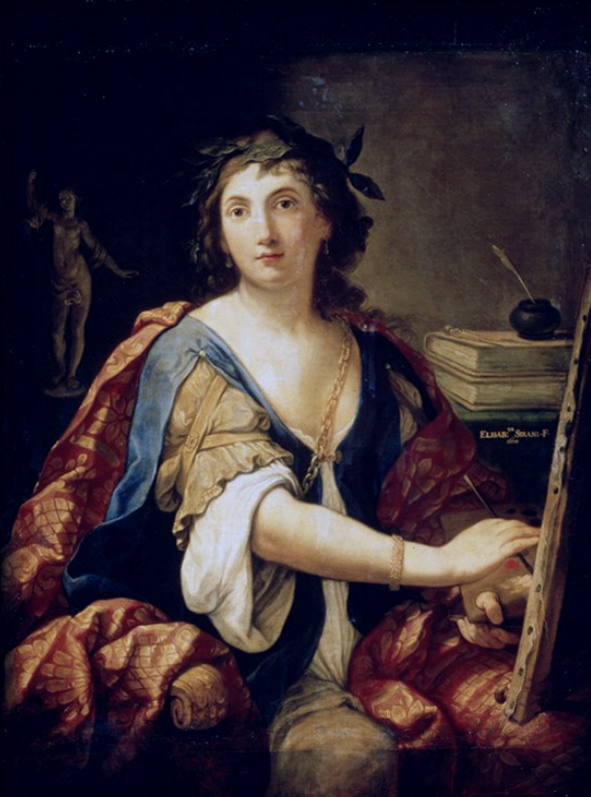
Elisabetta Sirani, Portia Wounding Her Thigh

Elisabetta Sirani, Portia Wounding Her Thigh, 1664
39.8 x 54.3 in.

Elisabetta Sirani (1638-1665) was an Italian Baroque painter and printmaker.  She was quite successful in her short life; she was the most famous woman artist in Bologna, and founded an academy for women artists.  Sirani was trained by her father, who had been a student of Guido Reni and was an established painter in the Bologna school.  When her father became incapacitated, she took over his workshop and studio at age sixteen.  She immediately became immensely successful.  Her success was made easier by the fact that Bologna was more progressive than other Italian cities and readily welcomed women artists.  In addition to success with her own paintings, she trained a number of other painters, including some men and over a dozen women (including her younger sisters).  Sirani painted, among other works, beautiful portraits, religious paintings, including the popular story of Judith and Holofernes, and a self portrait showing herself as the allegory of painting.  Portia Wounding Her Thigh is a scene from Roman history.  Portia Catonis was the wife of Brutus and some scholars believe she may have been involved in the plot to kill Julius Caesar, or at the very least was the only woman to know about it beforehand.  The scene illustrated here comes from Plutarch, who writes that she came upon her husband pondering the assassination but he would not confide his troubles to her, for fear that she would reveal the plot under torture.  To prove her ability to withstand physical pain, Portia cut her thigh and suffered in silence for a day (despite chills and fever).  She then returned to her husband with proof that she could keep her secrets.  This is a powerful painting, with strong and clear brushstrokes and forceful colors.  Portia is shown in a position of power; her pose conveys her strength and resolution.  The blood on her thigh contrasts effectively with her pale skin, but matches her red dress (the clothing of Sirani's day, not Portia's).  Portia is separated from the other women by her task and decision, essentially drawing her own blood to enter into the world of men.  This was a political painting for Sirani, meant to show the lengths women must go to in order to be taken seriously.  The painting is quite effective and rendered beautifully to tell us about both Portia's and Sirani's characters, their determination and intelligence.  Like Portia, Sirani surely felt she bled for her art.