Thursday, April 30, 2015

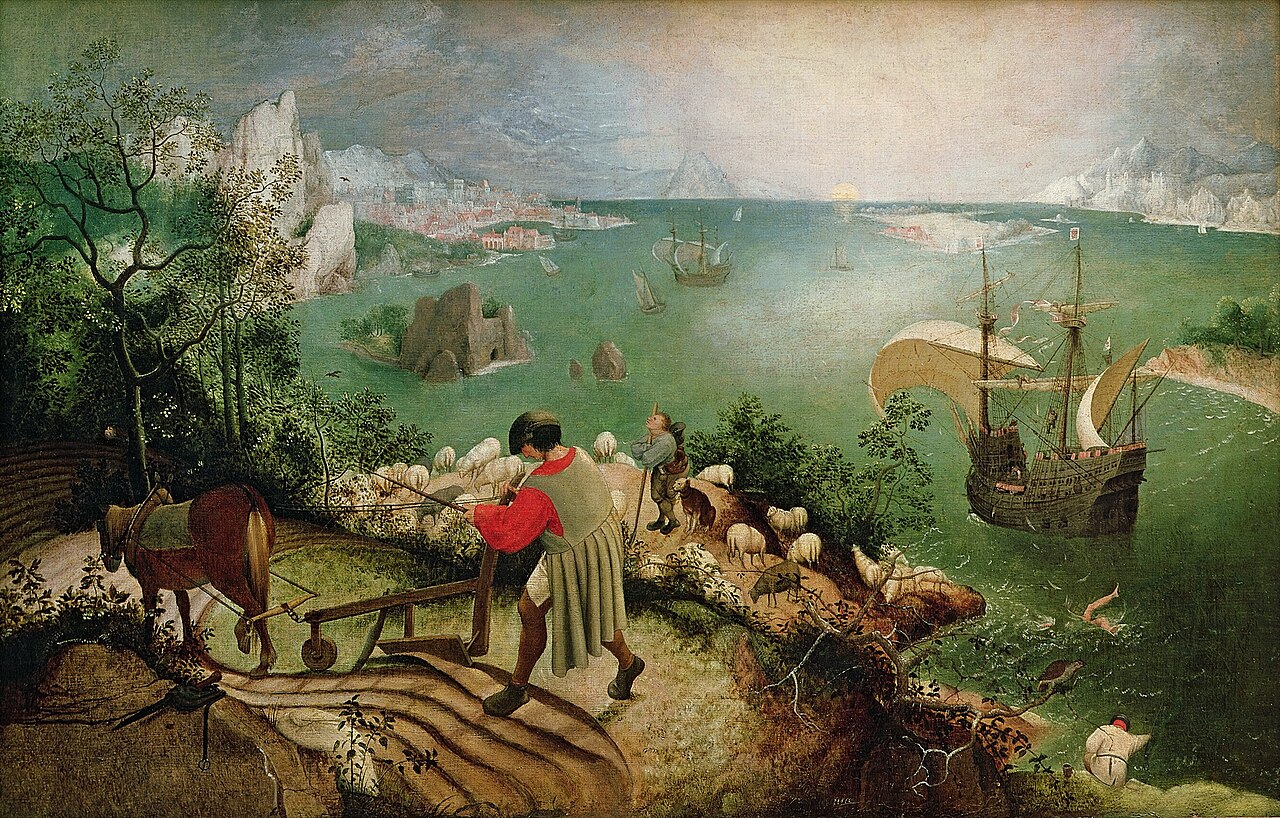
Peter Bruegel the Elder, Landscape with the Fall of Icarus

Peter Bruegel the Elder, Landscape with the Fall of Icarus, c1558
28.9 x 44.1 in.

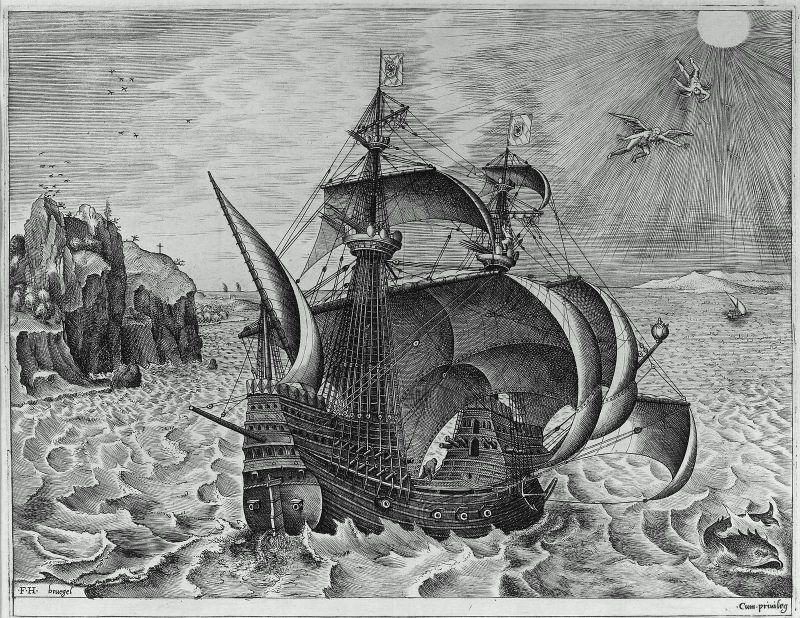
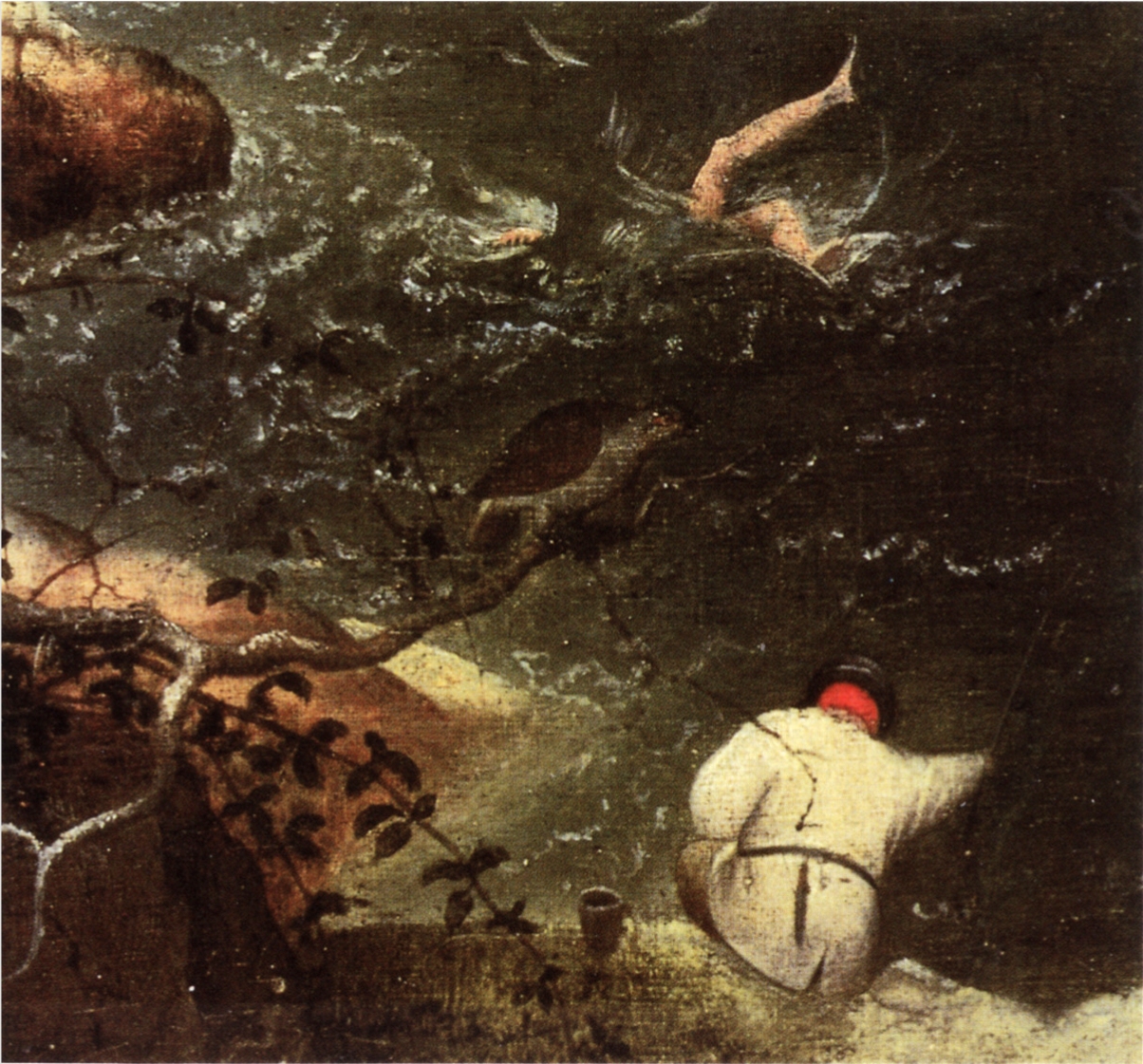
Peter Bruegel the Elder (1525-1569) was a Dutch Renaissance painter and printmaker, and one of the most major enduring figures of that group. Bruegel was born in or near the town of Breda and became an apprentice to the painter Pieter Coecke van Aelst, whose daughter, Mayken, Bruegel married. He traveled in France and Italy, and settled in Antwerp where he was accepted into the painter's guild in 1551. He later moved to Brussels. Bruegel had success in his life, receiving commissions from a number of wealthy patrons.  Both of his sons became successful painters, Peter the Younger and Jan the Elder. It is clear from his art that Bruegel was interested in the everyday lives of peasants and he even dressed up as a peasant to attend weddings and social events to gain inspiration and authenticity for his art. Indeed, peasant life is the subject of some of his most famous paintings. Landscape with the Fall of Icarus, a rather famous painting itself, is actually in the same vein. The authorship of this painting is actually in question and the version we have may in fact be a copy of Bruegel's original by one of his students or followers done around 1590, but the truth is unclear. Either way, it is Bruegel's own vision that is preserved for us. He devotes very little of the painting to the tragic death of Icarus, which one might expect to be the central and most exciting part of the painting. However, Bruegel shows us a different view of the myth. He depicted the story in an engraving from 1562 which shows an earlier moment of the story, with Daedalus flying and Icarus, too close to the sun, just beginning to fall. Even in that piece the father and son appear quite small compared to the ship and sea. In this painting, the beautiful landscape and laboring farmer are most prominent. The farmer on the cliff with his plow does not look up from his work, but a shepherd on the cliff below him does. He raises his head at the sound of a splash but is looking in the wrong direction and has no idea what has happened. In fact, Icarus is hard to see even for us. In front of the ship and near the shore, his leg sticks out from the water as he drowns. A nearby fisherman does not even seem to have noticed. This detail shows the small part of the painting where Icarus is seen. At first it may seem an odd choice to portray the myth in this way. However, it is quite profound and stunningly sad. Icarus flew too close to the sun and his wings melted, so he fell and drowned. But the world goes on without noticing. There is no stopping of work, no attempt to save him. No one even knows that his boy is dying. Nearby, Daedalus mourns and cries for his son, but here it makes no impact. Bruegel masterfully shows the senselessness of this death and the true tragedy of this life cut short.

Wednesday, April 29, 2015

Aleksandr Rodchenko, The Stairs

Aleksandr Rodchenko, The Stairs, 1930

Aleksandr Rodchenko (1891-1956) was a Russian artist who worked in many fields.  He was a painter, sculptor, photographer, and graphic designer.  He became an important spokesman in promoting the ideas of the government, particularly with his graphic design.  Born in St. Petersburg to a working class family, Rodchenko had not exposure to the art world when he decided to become an artist, drawing inspiration mostly from magazines.  He began studying at the Kazan Art School and then at the Stroganov Institute in Moscow.  There he created his first abstract drawings and paintings, influenced by the work of Kazimir Malevich, as well as Cubism and Futurism.  Rodchenko found success under the Bolshevik government and was given a bureaucratic job in which he helped found the Institute for Artistic Culture.  Rodchenko transitioned into photography, creating powerful portraits and images of the state apparatus.  The Stairs is a powerful and startling photograph.  Showing this woman alone, carrying her child is an evocative image.  Her loneliness appears to question the functioning of the state, especially in what looks like a central part of the city, but that may just be reading it with a modern eye. Certainly this woman appears powerful and determined.  The sharp contrasts and distinct shadows reinforce that impression.  The high vantage point and tilted angle of the photograph are quite off-puttting, putting the viewer in mind of something amiss and threatening.  While the meaning of this picture may not be entirely clear, the emotional resonances are undeniable and the depth and skill that Rodchenko brought to his work are evident.
Tuesday, April 28, 2015

Death of Polyxena from De Mulieribus Claris

Death of Polyxena, from De Mulieribus Claris, 1403

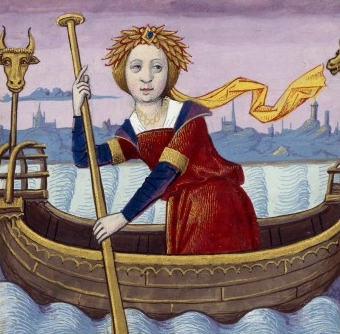
The artist behind this image is unknown, but it was created in France for a 1403 edition of Bocaccio's De Mulieribus Claris.  Bocaccio first published De Mulieribus Claris, which means "On Famous Women", in 1378.  It features the biographies of one hundred and six historical and mythological women, and is the first such collection devoted to women.  It begins with Eve and continues through Bocaccio's own time, ending with Joanna I of Naples.  It includes goddesses like Venus and Isis, mythological figures like Clytemnestra and Penthesilea, and historical figures like Cleopatra and Agrippina.  Bocaccio was inspired by Petrarch's On Famous Men and in turn influenced a number of similar works about women, including Chaucer's Legend of Good Women. I find this depiction of Polyxena particularly interesting.  Polyxena was a Trojan princess who was sacrificed at the end of the Trojan War to aid in the Greeks' return home (they left Greece with the sacrifice of an innocent girl, so no reason they shouldn't get back the same way). Polyxena is resigned to her fate and prefers to die in Troy than to live on as the slave to a Greek soldier (the fate of many Trojan women).  This illumination bears many hallmarks of medieval illustration, with its flat space and stilted poses, but there is also something extremely sophisticated bout it.  Most of this interest comes from the expression on Polyxena's face.  The artist managed to convey Polyxena's resignation and weariness, as well as her sadness.  This sadness is for herself and for her city and people, so utterly destroyed.  Even the Greek soldier's face is complex, registering something perhaps close to remorse.  Notice that Polyxena's hands are folded in her lap; she waits calmly for the sword to fall, a bitter end to the tragedy of Troy.

Monday, April 27, 2015

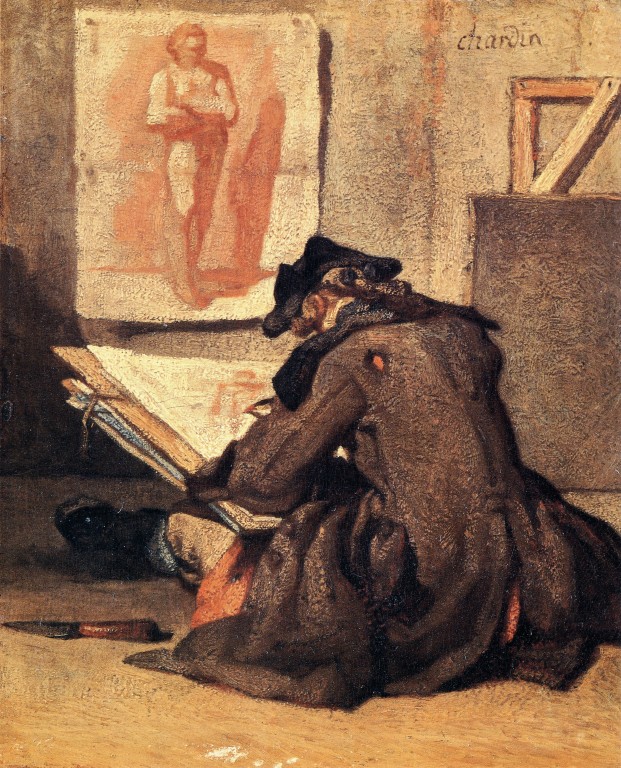
Jean-Baptiste-Siméon Chardin, Young Draughtsman

Jean-Baptiste-Siméon Chardin, Young Draughtsman, c1738

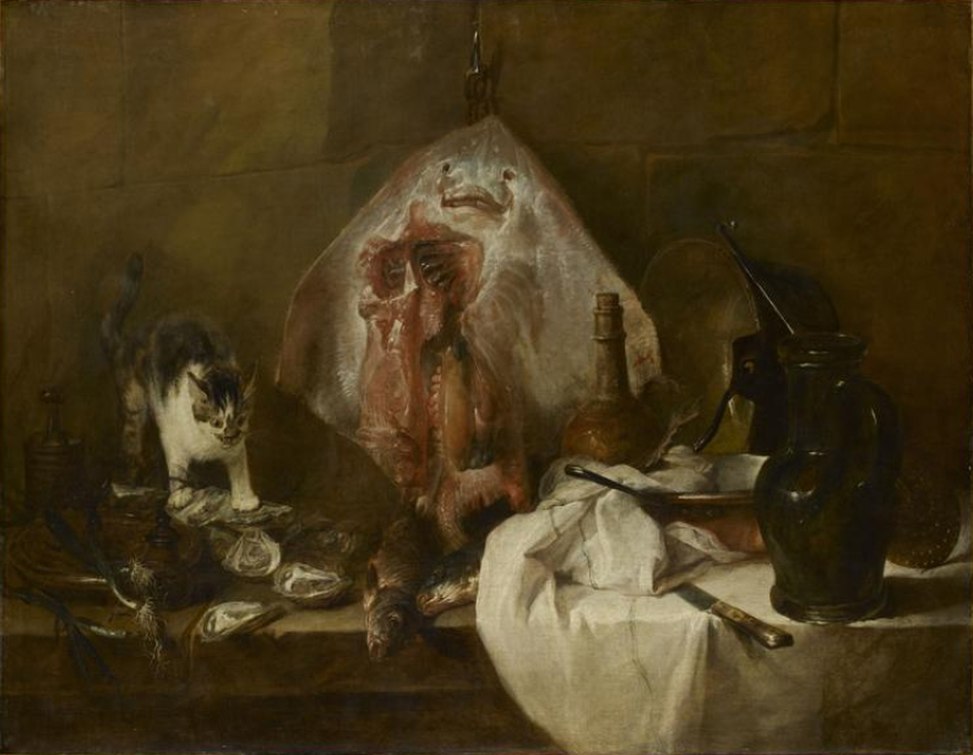
Jean-Baptiste-Siméon Chardin (1699-1779) was a prominent French painter.  Although he is often classified a Rococo painter due to his time period, Chardin's work had little in common with the ornate style and grand paintings of the movement.  Born in Paris, his father was a cabinetmaker. He became an apprentice to a number of established history painters and in 1724 he became a master at the Académie de Saint-Luc.  In 1728 Chardin was admitted to the Académie Royale up the presentation of The Ray.  Still-life became one of Chardin's primary genres, particularly scenes of hunted animals.  Chardin is best known for his intimate domestic interiors, often depicting the activities of young men.  Chardin elevated these drawings to the highest level and was considered one of the preeminent painters in France during his lifetime. This depiction of a young draughtsman is one of Chardin's most famous subjects, and he returned to it twelve times over a twenty year period.  Chardin was somewhat impatient with the arduous training young artists underwent, which this piece shows.  This artist, representative of Chardin himself (at least thematically), sits hunched over his sketch board in threadbare clothing and the warm coat suggests the studio is very cold.  The young man is learning to draw figures, first by copying a study by a master before eventually moving on to live models.  Notice the delicacy of Chardin's brushwork in the rendering of the coat, which is repeated in the texture of the canvas and wall. The piece also demonstrates masterful use of light and shadows to create the picture space. Some of the interest of the piece lies in the status of artwork.  This painting contains two or three other artworks within it: the original study being copied, the sketch the boy is producing, and the blank canvas to the right which will eventually become an artwork as well.

Sunday, April 26, 2015

Bartolomé Esteban Murillo, Two Women at a Window

Bartolomé Esteban Murillo, Two Women at a Window, 1655-60
49.25 x 41.125 in.

Bartolomé Esteban Murillo (1617-1682) was a Spanish Baroque painter.  Born in Seville, he was the youngest of fourteen children, but his parents died when he was young and was brought up by his aunt and uncle from then on.  Murillo began his art studies under the tutelage of Juan del Castillo, who first exposed him to Flemish painting.  Murillo's early works are influenced by great Spanish painters of the previous years, such as Zurbarán and Ribera, and he likely encountered the work of Velázquez when he moved to Madrid in 1642.  In some ways, Murillo's work became a synthesis of Flemish painting and these Spanish masters.  Although best known for his religious paintings, of which there are many, Murillo also painted a number of scenes of peasants and domestic scenes.  Two Women at a Window demonstrates Murillo's interest in everyday life and his excellent use of tenebrism.  The black background perfectly emphasizes the presence of these women.  These smiling women are likely an upper class pair (covering your mouth while laughing was considered good etiquette among Spanish aristocracy) and the standing woman may be the younger girl's chaperone.  It is important to note that these figures are life size and they are very convincingly modeled.  Murillo's skill is evident in the use of brushwork and shading to render these women.  The use of a window opening to frame the painting and simulate a real window is a trick from Dutch painting.  With the open window, life sized figures, and realistic depiction, and given the right setting, the painting could be mistaken for a real window with a real pair of laughing women––at least for a moment.

Saturday, April 25, 2015

Hanna Pauli, Breakfast Time

Hanna Pauli, Breakfast Time, 1887
36 x 34 in.

Hanna Hirsch-Pauli (1864-1940) was a Swedish painter who played a major role in the Scandinavian art scene of the late 1800s.  She was born in Stockholm and attended the Royal Swedish Academy of Arts there.  Like many Scandinavian artists at the time, her work combines elements of Impressionism and Realism.  Among her best known works is her portrait of sculptor Venny Soldan.  The piece shows a realistic style and sensibility and and extremely nuanced rendering of Soldan.  The portrait was accepted to the Paris Salon in 1887.  That same year Hirsch married Georg Pauli.  The home they made together became a gathering place for the leading Swedish cultural figures of the day.  Breakfast Time is probably Pauli's most famous painting.  It features soft, layered brushwork and warm, rich textures.  The painting features an unusual composition, where the well-appointed table becomes the focus of the piece and the single figure recedes into the background.  The painting skillfully combines still-life, portrait, and landscape to create a very complex painting.  Another interesting element is the use of light; the sun shines through the trees to create a dappled effect that instills the viewer with the feeling of shade on a warm day.  The light glints on the tea kettle and other features of the spread, while again casts the woman into shadow.  Pauli is demonstrating the way in which this woman, apparently a server, becomes a feature of the breakfast herself.  Meanwhile the finely rendered landscape is brightly lit, creating an effect of the wide and beautiful landscape that lies just beyond the picture space.

Friday, April 24, 2015

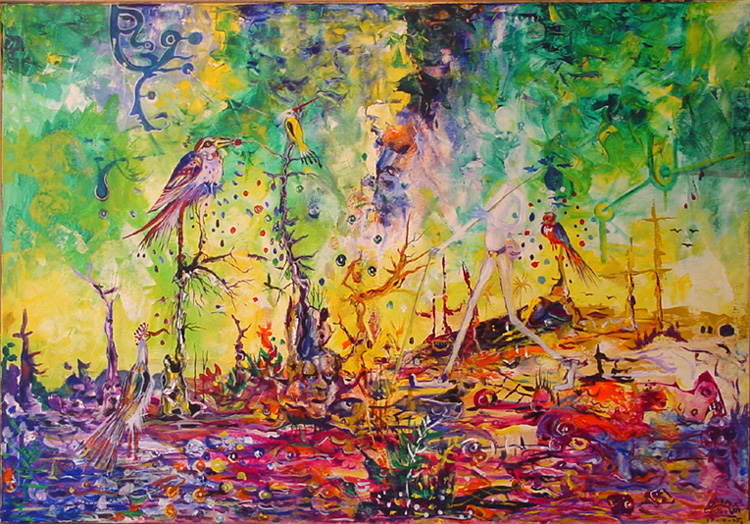
Nzante Spee, The Wahdoosee Question

Nzante Spee, The Wahdoosee Question, 1994

S. Nzante Spee (1953-2005) was a Cameroonian artist.  Born in Mbem, Cameroon, he began his artistic career by painting signs and façades for local businesses.  In 1976 he began to study fine arts in Nigeria and Côte d'Ivoire and by the time he finished in 1982 he had already made a name for himself as a great talent.  In the following years he won a number of awards in Africa and began participating in international exhibitions, particularly in France.  Spee became an influential figure in Cameroon, where he had to fight to make a place for himself as an artist in society.  He has inspired countless young artists in Cameroon to pursue their work.  Spee's particular style combines elements of traditional African art with European styles, especially Surrealism and Cubism.  Spee's work is inspired by music and movement with bright colors that show the intense ecstasy with which he experienced the world.  The Wahdoosee Question is exemplary of Spee's style.  There is intensely surreal imagery presented, with bright birds and distorted people populating the space.  Faces hang in the bright green sky and shapes that seem almost identifiable blanket the ground.  This is an imposing painting, whose brightness and complexity make it difficult to read but highly intriguing.  I find the painting powerful and effective, giving us a glimpse of how Nzante Spee saw the world.