Wednesday, July 1, 2015

Tom Roberts, Twenty Minutes Past Three

Tom Roberts, Twenty Minutes Past Three, 1886
39.37 x 29.25 in.

Tom Roberts (1856-1931) was a major Australian painter.  Born in Dorset, England, his parents were newspaper editors there until the family moved to Melbourne in 1869.  Roberts worked as a photographer's assistant in the 1870s and he began studying art at night.  In 1881 he returned to England to study painting at the Royal Academy Schools until 1884.  His early work shows a strong inclination toward Orientalism, which developed into an Impressionist or Post-Impressionist aesthetic.  Roberts painted many landscapes and portraits, but was perhaps best known during his lifetime for his large-scale paintings exploring aspects of Australian life, such as Shearing the Rams (1890) and The Big Picture (1903).  To my eye, Twenty Minutes Past Three is a stunningly interesting and hauntingly beautiful painting.  The red of the room, the warm light from the lamp, the stark use of shadows, all make this work engaging and fascinating. However one of the most fascinating elements is the overwhelming sense of unknown.  We have no idea the context or content of this scene.  The woman has put aside her reading and risen from the table as the man edges around the door.  We can just make out the clock face reading 3:20. Perhaps her husband has stayed out to the wee hours of the morning and she expected him home.  One analysis I read suggested that he has been engaged in a futile search for their missing child.  It is impossible for us to know, but the woman's anxiety is palpable.  Roberts also places the action far back in the picture space, she in the middleground and he in the background, leaving the foreground relatively empty save for shadows.  This makes us want to be closer to these figures and gives us space to enter into the scene.  Although we do not know what is happening in this interaction, the painting is charged with tension and fraught emotion, which Roberts skillfully employs and conveys in this unusual and somewhat maddening painting.

Tuesday, June 30, 2015

Pieter de Hooch, Interior with Women beside a Linen Closet

Pieter de Hooch, Interior with Women beside a Linen Closet, 1663
27.6 x 29.7 in.

Pieter de Hooch (1629-1684) was a painter of the Dutch Golden Age.  Born in Rotterdam, his father was a bricklayer and his mother was a midwife.  He studied in Haarlem, where he apparently began developing his reputation for interiors, often with men and women in conversation.  De Hooch returned to Rotterdam where he became painter in service to a linen merchant and art collector.  This appointment caused to travel extensively around the Netherlands, including Delft where he eventually moved.  One of De Hooch's most famous works was from this period.  Moving to Delft in 1654, de Hooch joined the Guild of St. Luke, where he was a member at the same time as Johannes Vermeer.  Some of de Hooch's works from this period strongly resemble Vermeer.  De Hooch's reputation grew, and he became known for his quiet domestic scenes with open doorways.  This motif often led to rather complex compositions. Like most Dutch painters of the time, de Hooch also demonstrates a clear interest in the complex and beautiful ways that light shapes a scene.  The interior scene I have featured exhibits both of these tendencies.  It contains de Hooch's signature open door, which in this case opens to reveal a significant distance to the courtyard.  In this piece he also included a second egress–the stairs  that lead to the next story at the edge of the painting.  The scene contains some natural light from that distant doorway, and perhaps some that shines onto the doors of the linen closet, but overall the scene is rather dark and the figures are in shadow.  However there also seems to be light coming from just beyond the staircase, where the wood is lighter and warmer at the very top of the stairs.  The warm wood color also appears on the linen closet and the beam on the ceiling.  Meanwhile, the painting is quite intricately detailed, from the architecture in the minuscule courtyard, to the beautiful pattern of the linen basket, the art on the wall, and the small bowl that sits on top of the wardrobe.  The spatial complexity of this painting gives it a lot of its interest, but the rich colors and the palpable presence of the figures also create a painting of great depth and beauty.

Monday, June 29, 2015

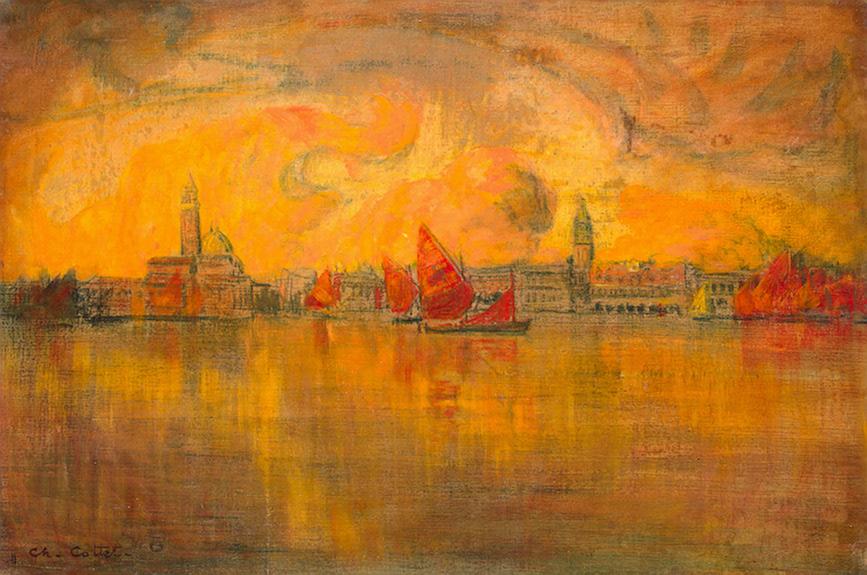
Charles Cottet, View of Venice from the Sea

Charles Cottet, View of Venice from the Sea, 1896

Charles Cottet (1863-1925) was a French painter known for his seascapes and landscapes of Brittany.  Cottet studied at the École des Beaux-Arts under Puvis de Chavannes, as well as at the Académie Julian, where he became friends with the painters who would form Les Nabis (which Cottet was not a member of but was associated with).  He traveled extensively, spending time in Egypt and Italy and on Lake Geneva to paint.  However, he found his true inspiration on a trip to Brittany in 1896.  He became known for his dark, evocative scenes of Brittany and exhibited in the Salon in 1899.  Cottet's seascapes are rather unusual, giving a strong sense of the scope of the sea and invoking a strong mix of calm and power.  This view of Venice is also rather unusual. There are strong elements of fantasy here, with the intense gold coloring and swirling clouds. Cottet makes Venice appear like a magical city beyond the shimmering water.  There is also a somewhat sketch-like appearance to this piece, which adds to the fantasy, as though the scene is glimpsed through a dream.  Cottet painted another similar version of the scene, with, perhaps, more realistic coloring, and more movement in the water.  In the painting I have featured, the water appears glassy, a mirrored surface to reflect the boats and city.  Everything is aglow in the bright light of sunset.

Sunday, June 28, 2015

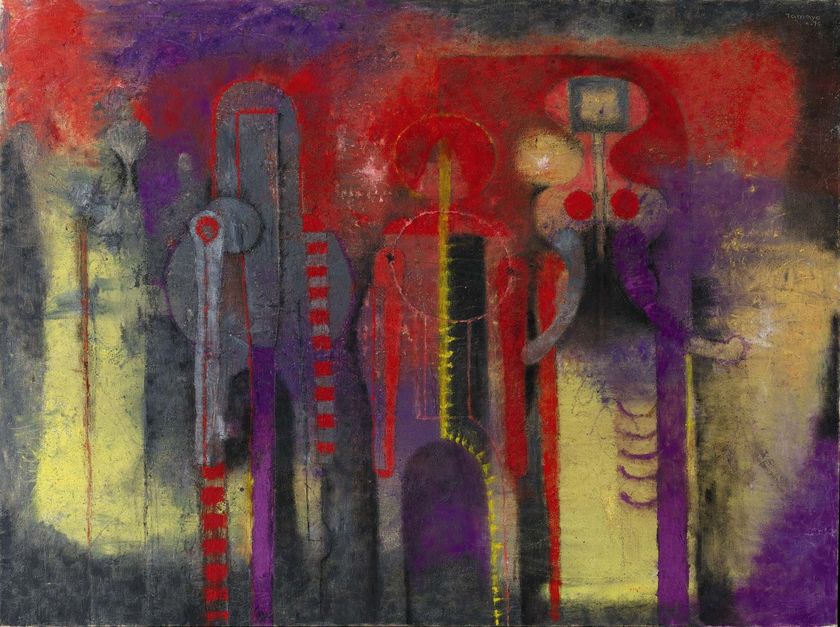
Rufino Tamayo, Tres Personajes

Rufino Tamayo, Tres Personajes, 1970
51 x 38 in.

Rufino Tamayo (1899-1991) was a Mexican painter.  Born in Oaxaca, he was of Zapotec descent, which is often cited as an important influence on his work.  After his parents died, Tamayo moved to Mexico City to live with his aunt and help with the family business.  However, recognizing his talent, his aunt enrolled him in the Escuela Nacional de Artes Plasticas in 1917. While in school, he experimented with the leading genres of the time, including Cubism, Impressionism, and Fauvism, always adding a distinctly Mexican character to these styles.  Over time, Tamayo found his own style, mixing traditional art with modernism, and influenced by abstraction and Surrealism.  In 1926, he left Mexico and moved to New York, although he spent significant amounts of time in both New York and Mexico CIty for the rest of his life.  Tres Personajes (Three People) is a stunning example of Tamayo's skill and style.  It is abstract, almost entirely, and employs bright colors and mysterious shapes.  The painting also features Tamayo's signature rough painting surface, achieved by mixing sand and ground marble dust into the paint.  The piece is generally seen to contain one female figure, one male, and an androgynous figure in between. While I can certainly see those elements, to me the painting isn't about the figures, it is about shape and color.  The intense palette seems like the main subject of the painting, and Tamayo used interesting shapes to utilize those colors and convey their effect. Even the use of grey and black is very powerful.  This painting was stolen from a Houston warehouse in the late eighties and became the subject of an FBI investigation, but it never turned up.  It was discovered in 2003, nestled between two trash cans in Manhattan at the corner of 72nd St and Broadway by one Elizabeth Gibson, who knew little about art but was compelled to take the painting home.  The trash was picked up twenty minutes later.  It took some three or four years and a lot of research, but Gibson eventually discovered that she had a famously stolen painting.  She contacted Sotheby's who confirmed the painting's authenticity.  Gibson received a finder's fee and reward and the painting was sold on behalf of the original owner.  No culprit has ever been identified and no one knows how it ended up in the trash on that particular corner, but this masterpiece, which had been given up for lost by the owners, was miraculously discovered and saved.

Saturday, June 27, 2015

Karl Blossfeldt, Plate #96: Aconitum

Karl Blossfeldt, Plate #96: Aconitum, printed in 1928

Karl Blossfeldt (1865-1932) was a German photographer and sculptor.  He studied at the University of Fine Art in Berlin and later taught at the Berlin Arts and Crafts School, which became a very important part of his life.  Blossfeldt inherited his father's love of music and nature; as a boy he played in local fields and woods, collecting flowers and plants to make a small garden near his house.  We can see the influence of these experiences in the enlarged photographs of flowers and plants that make up the majority of his oeuvre.  Blossfeldt produced a very wide variety of such images, displaying stunning detail and intricacy.  Given Blossfeldt's incredible output, I had a great deal of difficulty choosing an image to feature in my post.  There were so many choices that I found fascinating.  I eventually settled on this image of aconitum (aconite) also known as monkshood and wolf's bane, among other names.  I find the plant and the photograph very interesting; there is an anthropomorphic quality, as though the stalk and leaves actually form a person (this is not unique among Bossfeldt's works).  Aconite is extremely poisonous, sometimes even called the queen of poisons, and has been used to tip arrows in hunting and is used in murder.  It is believed by many that Cleopatra killed her brother, Ptolemy XIV, with aconite.  I think this adds another dimension to the photograph, and I began to see the person in pain, raising their arms (leaves) above their head.  There is also an excellent use of light in this photograph, using areas of shadow to make the plant stand out in starker relief and show its shape.

Friday, June 26, 2015

Konstantinos Volanakis, The Burning of a Turkish Frigate

Konstantinos Volanakis, The Burning of a Turkish Frigate
35.5 x 51.5 in.

Konstantinos Volanakis (1837-1907) was a prominent Greek painter, best known for his many seascapes, a genre which he helped establish in modern Greek painting.  Born near the city of Rethymno in Crete, his family moved around a lot, eventually settling on the island of Syros in the Cyclades.  After completing school, Volanakis went to Trieste to work as an account for a Greek family he was related to.  While there, he began sketching ships and harbors.  His employers (who were also family) recognized his artistic talent and arranged for him to study at the Academy of Fine Arts in Munich.  His first success came in 1869 when Emperor Franz Joseph held a drawing competition to commemorate the Battle of Lissa, which had occurred three years previously. Volanakis won the contest for his stirring and epic depiction of the battle, winning one thousand florins and free travel with the Austrian navy for three years.  This proved invaluable to Volanakis, as he traveled with the navy, sketching and painting the ships and harbors he saw. Many of his paintings also resemble genre scenes in content, showing children on the beach or the toil of working fishermen.  He also painted some landscapes and mythological scenes.  The Burning of a Turkish Frigate is an extremely intense and intricate piece.  Its subject is a tactic from the Greek War of Independence.  Greek revolutionaries would row a small boat laden with explosives up to the side of a large Turkish frigate.  The strategy was quite successful and contributed to the success of the Greek revolt.  In one case in 1821, the fire aboard the Mansourija was so large that it killed 600 Turkish sailors.  The painting does an excellent job depicting the extent of the blaze.  To the right of the frigate, we can see the small Greek ship still burning, leaning against the side of the Turkish ship.  Notice the detail that Volanakis included in the Turkish scramble to escape and the texture of the rising smoke.  The scene is contained within the context of a masterful seascape, where the waters churn and clouds blanket the sky. Just beyond this disaster, the sea is calm, reflecting the deep twilight blue of the sky.

Thursday, June 25, 2015

Ernst Ludwig Kirchner, The Red Tower in Halle

Ernst Ludwig Kirchner, The Red Tower in Halle, 1919
47 x 36 in.

Ernst Ludwig Kirchner (1880-1938) was a German Expressionist painter and one of the founders of the expressionist group Die Brücke (The Bridge).  Born in Bavaria, his family moved frequently and Kirchner attended a number of different schools in Frankfurt and Perlen.  Eventually the family settled in Chamnitz, once Kirchner's father had secured a job as a professor.  Kirchner attended the royal technical university in Dresden, where he studied architecture and engineering, as well as art.  Among Kirchner's biggest influences, especially early in his career, were Matisse and Gauguin.  The work of the two great modernists was crucial in the development of Expressionism.  In 1905, Kirchner founded Die Brücke with his friend Fritz Bleyl and two architecture students, Karl Schmidt-Rottluff and Erich Heckel.  The group intended to break away from traditional academic painting to find a new mode of expression, and a bridge between the past and present.  Kirchner worked in landscape and portrait, developing his own unique style. Among his most celebrated and powerful pieces is Self-Portrait as a Soldier (1915).  The Red Tower in Halle demonstrates this particular style, featuring a distorted landscape and unusual perspective.  With chalky colors and monumental forms, just outside the realm of normal perception, the painting is rather disconcerting.  There is an erie or ominous sense to it; perhaps those are storm clouds rolling in in the background.  The red tower was a minor landmark in the southern city of Halle, but perhaps there was some prescience in Kirchner's piece.  The tower was destroyed by an artillery fire in 1945 when the city was occupied by American troops.  After a great deal of success, and being seen as one of the leading figures of modern art in Europe, Kirchner's work was labeled degenerate by the Nazis in 1937.  Twenty-five of his paintings were exhibited in the famed Degenerate Art Exhibition that year.  Kirchner was expelled from the Academy of Arts in Berlin, and he went to Switzerland with his partner, Erna.  He held an exhibition in Basle to mixed reviews.  Thoroughly depressed over the actions of Germany, and with fears that they would invade Switzerland after Poland, Kirchner took his own life by gunshot in 1938.