Friday, July 31, 2015

Joan Miró, People at Night, Guided by the Phosphorescent Tracks of Snails

Joan Miró, People at Night, Guided by the Phosphorescent Tracks of Snails, 1940
14.94 x 18 in.

Joan Miró (1893-1983) was a major Spanish/Catalan artist, an important figure in the development of modern art.  Born in Barcelona, he began drawing lessons at age seven.  He studied at the fine art academy at La Llotja and then at the Cercle Artistic de Sant Lluc.  Miró had his first solo show in 1918, but his work was ridiculed.  His early work shows a mixture of influences, particularly traditional art and Fauvism.  After the failure of his first show, Miró moved to Paris where he hoped the artistic community at Montparnasse would be more receptive. Influenced by Cubism and Surrealism, he began to develop his own aesthetic.  His style really took form in the mid-twenties, when his particular use of color and geometry produced works of great complexity and originality.  Miró's two most famous pieces are from this period: Dancer (1925) and the highly symbolic Birth of the World (1925).  While he utilized similar elements for the rest of his career, his late work is quite diverse and striking.  The painting I have featured is from a series of small paintings generally known as Constellations.  There are twenty-three of them, each as complex and beautiful as the last.  People at Night, Guided by the Phosphorescent Tracks of Snails is unusual in the series for its blue background, which gives the appearance of nighttime.  These figures and shapes swirl around each other in the night sky. Miró tells us that they are guided by the phosphorescent tracks of snails, the spheres of light along some of the lines.  There is indeed a phosphorescence in this piece, a luminosity that draws me to it and makes me want to gaze into the inky blue and follow the lines in stark black and red.

Thursday, July 30, 2015

Paul Jenkins, The Archer

Paul Jenkins, The Archer, 1955
51 x 31 in.

Paul Jenkins (1923-2012) was an American abstract painter.  Born in Kansas City, Missouri, as a boy Jenkins met Frank Lloyd Wright when he was hired by his uncle to rebuild a church.  The great architect encouraged the young Jenkins to pursue agriculture rather than art.  His uncle then encouraged Jenkins to visit Thomas Hart Benton, who encouraged Jenkins in his aspirations. After serving in the Navy, Jenkins moved to New York in 1948 and studied at the Art Students League.  Around this time, Jenkins met leaders of the first generation of Abstract Expressionists—Mark Rothko, Lee Krasner, Jackson Pollock, and Barnett Newman.  In 1953 he traveled to Europe and eventually settled in Paris, divinding his time between Paris and New York.  His first solo exhibition was held in Paris in 1954.  His first important sales were Divining Rod (1956), purchased by the Whitney Museum, and Peggy Guggenheim's purchase of Osage (1956). Although he always worked in pure abstraction, Jenkins's paintings do evoke natural formations like mountains, waves, amber, or marble.  Beginning around 1960, Jenkins moved away from oils toward acrylics, creating pieces that appear as veils of color.  Although they look like staining, they were produced with pouring and spreading with an ivory knife.  He frequently used the word phenomena in his titles, giving his work an air of the supernatural.  Later works like Phenomena Astral Tundra (1986), Distance Finding Mozart (1992), and Phenomena Wind Arch (2009) use a similar technique but continue to explore its diverse possibilities.  The Archer is one of Jenkins's earliest pieces, demonstrating the rich texture and dense composition that marks his early work. There is possibly a vague human figure with a bow drawn suggested in the black that forms something of a background, but mostly the painting is an explosion of color with all sorts of shapes and sights available to the viewer's interpretation.  To me there is ecstasy here, with the possibility of being overwhelmed by the intensity of these colors.

Wednesday, July 29, 2015

John Singer Sargent, Fumée d'Ambre Gris

John Singer Sargent, Fumée d'Ambre Gris, 1880
54.75 x 35.7 in.

John SInger Sargent (1856-1925) was a major American artist, often considered the leading portrait painter of his generation.  Although his parents were American, Sargent was born in Florence and spent most of his life in Europe; his parents became nomadic expatriates, mostly based in Paris, after the death of John's older sister at age two and his parents decided to go abroad to recover.  Sargent demonstrated a talent for art from childhood and first had painting lessons at age thirteen.  He began formal training with the painter Carolus-Duran, before being admitted to the École des Beaux-Arts.  Sargent had his first painting accepted to the Salon in 1877, with his 1879 painting of Carolus-Duran his first major success.  Sargent painted indoor and outdoor scenes of society and family, as well as landscapes, works with social commentary, and unconventional cultural scenes.  Among his most famous and well-regarded paintings is Portrait of Madame X (1884), although at the time it was highly controversial for the model's attire and rumored infidelities.  The model, Virginie Gautreau, was humiliated by the incident and Sargent was devastated; the failure of the piece was a huge blow to his burgeoning career in Paris.  Soon after its exhibition, Sargent moved to London where his success continued unabated.  Among the major figures Sargent painted were Robert Louis Stevenson, John D. Rockefeller, and most famously Theodore Roosevelt.  Fumée d'Ambre Gris (Smoke of Ambergris) is a beautiful painting, now hanging in the Clark Art Institute.  It is simultaneously rather simple and quite complex.  The use of such limited tones gives the painting an air of mystery, as well as invokes the sense of the Orient, for it was painted on a trip to Tangier.  To create the gradations in texture and atmosphere with so little color require great skill and care. Ambergris, a resin excreted by whales and found in seawater, was believed to be an aphrodisiac and to ward off evil spirits.  Henry James praised the painting as "exquisite, a radiant effect of white upon white," and says the woman is "beautiful and memorable."  Indeed, we can see very little of the woman's face, but her beauty and mystery entice us to gaze at the painting to penetrate the world presented, in fact a fantastical and hodgepodge portrayal of its locale.  Lifting her veil so slightly, the subject simultaneously evokes a nun and a geisha.  The subtle and enveloping whiteness of this piece, made possible by its miraculous use of light, is beautiful and intensely engaging, shining with a bright mystique.

Tuesday, July 28, 2015

Matthew Smith, Yorkshire Landscape

Matthew Smith, Yorkshire Landscape, c1935
20 x 24 in.

Matthew Arnold Bracy Smith (1879-1959) was a British painter.  Born in Halifax, he studied at the Manchester School of Art and then the Slade School of Art in London.  In 1908 Smith traveled to France where he studied under Henri Matisse, whose influence can be seen in some of his work. Smith was also influenced by Fauvism in general, taking the style to extremes.  Many of his other landscapes show a distinctly Impressionist or Post-Impressionist influence.  In addition to landscapes, Smith painted portraits, often nudes, and some very Cezanne-inspired still-lifes. Smith had a very successful career and was knighted in 1954.  The landscape I have featured, painted in Smith's home county of Yorkshire, stands out among his oeuvre, showing less influence of other painters and styles.  Using rather thick and visible brushstrokes, the piece creates a powerful expression of this tree and hillside.  The purple sky tinges the whole painting with an element of fantasy, which when combined with the thick canals of paint, draws attention to itself as representation rather than reality.  Nevertheless, the painting is an intensely effective portrayal of its subject, showing the wind and wildness that whips across this hill.

Monday, July 27, 2015

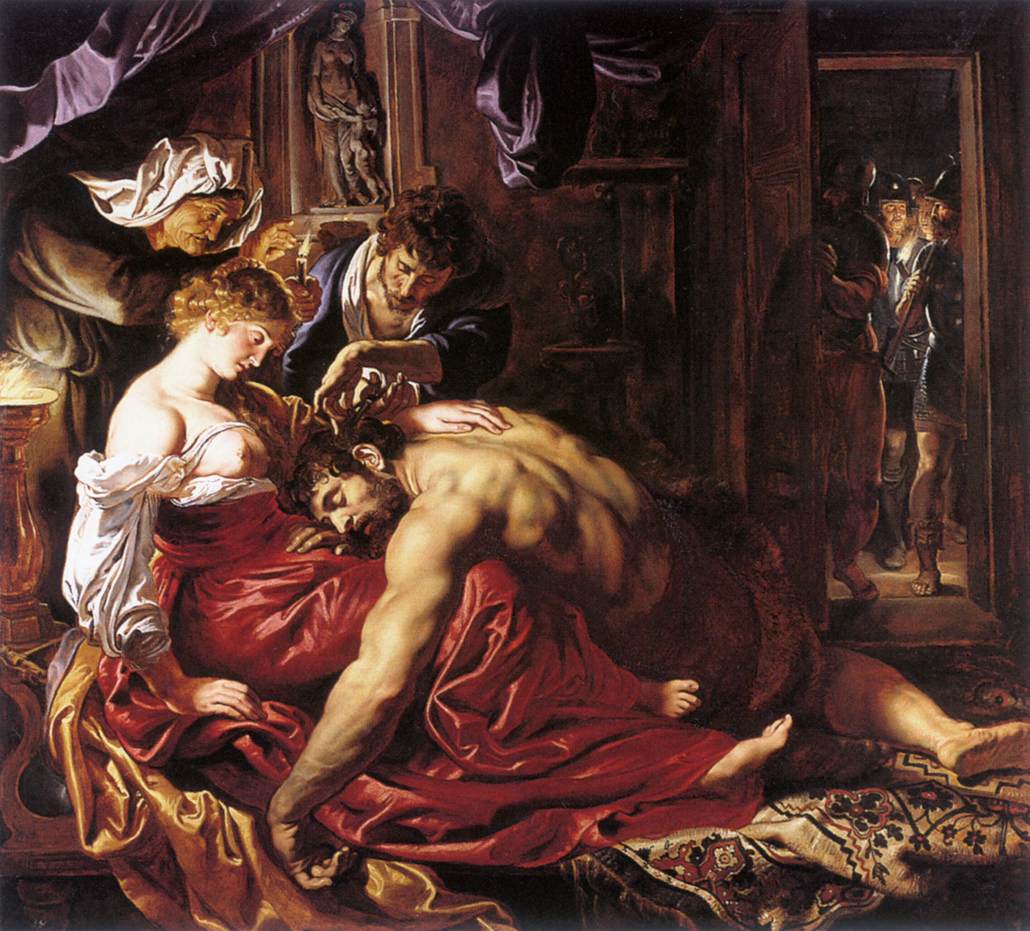
Peter Paul Rubens, Samson and Delilah

Peter Paul Rubens, Samson and Delilah, 1609-1610
73 x 81 in.

Peter Paul Rubens (1577-1640) was a Flemish Baroque artist and one of the most influential painters in the history of art.  His father was a Calvinist and his parents fled Antwerp for Cologne in 1568 due to persecution of Protestants, however after the death of his father in 1587, Rubens was raised Catholic by his mother, Maria Pypelincks.  Religion played a major role in Rubens's work and he would go on to become a major voice of the Catholic Counter-Reformation.  Rubens received a humanist education before being apprenticed to some of the leading artists of the day. After joining the Guild of St. Luke in 1598, he traveled to Italy where paintings by Italian masters and Classical sculpture had a profound impact on him.  Throughout his prolific career, Rubens mostly painted mythological scenes, religious works, and portraits.  In addition to his prodigious technical skill, Rubens gave his subjects a profound humanity, such as in Virgin in Adoration of the Christ Child (c1615) where the adoration he expresses is really the love of a mother for her child.  Among his best known works is the extensive Marie de' Medici Cycle, depicting the life of Marie de Medici and her husband Henry IV of France.  Despite its size (twenty-four paintings) and grandeur (each about 13 x 10 feet), the series was never completed due mostly to the exile of the queen in 1630 by her son, Louis XIII.  Samson and Delilah is a relatively well known painting, now hanging in the National Gallery in London.  Having fallen in love with Delilah, Samson tells her that his uncut hair is the source of his strength.  Now he has fallen asleep in Delilah's lap and a servant cuts his hair.  Philistine soldiers wait outside the door to arrest the weakened Samson. Notice Delilah's expression.  She appears guilty and uncertain of what she is doing, torn between the agreement she has made and her feelings for this man whom she has seduced.  This differs from the biblical narrative but it seems clear in Rubens's version.  The complexity of this composition is a remarkable achievement, both in the arrangement of the figures and the elaborate setting.  Elements such as Samson's musculature, Delilah's flesh, and her draping gown are all outstandingly rendered to create a painting of great intensity and impact.

[Note: My apologies to my readers for the lack of discussion in my last two posts.  I have been injured and not felt up to writing full entries.  I hope to edit them in the next few days.]

Sunday, July 26, 2015

Saturday, July 25, 2015

Fernand Léger, Branches (Logs)

Fernand Léger, Branches (Logs), 1955

Due to my own run-in with a tree branch, I will skip the discussion for tonight.