Monday, December 1, 2014

Alfred Sisley, Still Life: Heron with Spread Wings

Alfred Sisley, Still Life: Heron with Spread Wings, 1867
39.37x31.89 in.

Alfred Sisley (1839-1899) was a core member of the Impressionist group.  Born in Paris to British parents, Sisley spent most of his life in France but maintained a strong connection to Britain. Known mostly for his work in landscape, which displays quite a range, Sisley was the most devoted to en plein air painting of the Impressionists and rarely explored figure painting.  Among his most noted works are paintings of the Thames and depictions of the Moret commune, which also exhibit a stylistic range.  This painting of a dead heron is rare still life of Sisley's, but utilizes the same ideals that he brought to his landscape painting.  Among his chief interests were the way light hits different surfaces, depicting the everyday, and exploring the relationship of subjective experience to reality.  We can see all of these elements at work in this piece.  The use of light is quite pronounced, illuminating the body of the heron while the background remains in shadow; the heron's wings also stretch into the shadow, emphasizing the breadth of the bird's wingspan and alluding to its majestic flying ability, now extinguished.  Lying with the heron are two other birds, presumably killed in the same hunting trip.  The painting is a fascinating exploration of emotions surrounding death, for this bird, most likely killed for sport, is arranged to show the gruesomeness of such a kill.  The lifelessness of these birds is foregrounded, with the heron's feet strung up.  Sisley's painting is about the unnaturalness of the scene, despite its normalcy.

Sunday, November 30, 2014

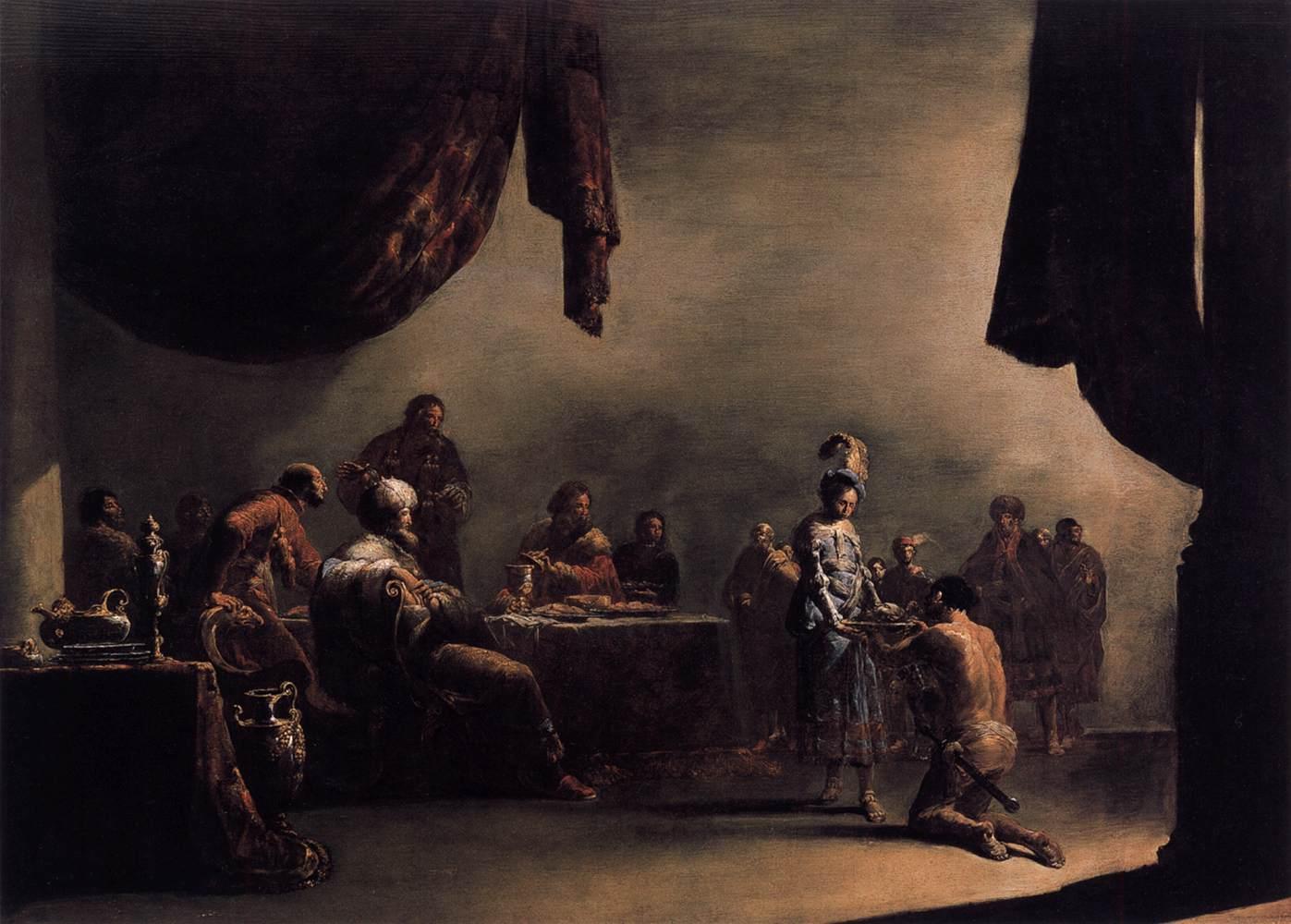
Leonaert Bramer, Salome Presented with the Head of St. John the Baptist

Leonaert Bramer, Salome Presented with the Head of St. John the Baptist, 1630s

Leonaert Bramer (1596-1674) was a noted Dutch painter who achieved success with religious works, history painting, and genre scenes.  Born in Delft, Bramer traveled extensively and spent quite a bit of time in Rome where he earned the nickname Leonardo of the Night for his particular skill with nocturnal scenes.  Salome is a very interesting painting for its starkness and use of dramatic techniques.  The story of Salome, Herod, Herodias, and John the Baptist is a favorite of painters throughout the centuries.  Usually, though, there is a great deal of attention paid to the head of John, yet here it is barely visible.  Instead the scene is quite expansive, showing King Herod and his banquet table.  Bramer applied his facility with nighttime painting to this interior piece, resulting in unusual lighting.  The blankness of the background, carefully rendered to be both appropriate to the dimly lit room and suggestive of a cloudy night sky, is quite striking, drawing the viewers attention to the figures, but also evoking the brutality and violence of the story.  The inclusion of curtains, not necessarily out of place in a banquet scene of the time, enhances the overall drama of the scene, and draws attention to the figures of Salome (the only person in 17th century dress) and the executioner, who do not stand under either curtain but the shadow on the right frames them and mirrors their own shadows.  The highly theatrical painting leaves the viewer with a sense of unease.

Saturday, November 29, 2014

Nikolaos Gyzis, The Secret School

Nikolaos Gyzis, The Secret School, 1885

Nikolaos Gyzis (1842-1901) was among the most prominent Greek painters of the nineteenth century.  Gyzis was trained at the Athens School of Fine Arts in the movement known as the Munich School because many Greek artists trained at the Royal Academy of Fine Arts of Munich. After his study at Athens Gyzis himself won a scholarship to Munich and stayed there for many years.  The style emphasized a prominent but soft use of chiaroscuro and, particularly in the case of Gyzis, often depicted genre scenes.  The Secret School (also translated as The Underground School) makes an appropriate companion to yesterday's post post about the Ottoman Empire, for this painting is about Greece under Ottoman rule.  Greece was conquered by the Ottomans in the mid-fifteenth century (Athens fell in 1458) and was part of the empire until declaring independence in 1821.  Popular myth in Greece held that Ottoman rule prohibited, or at least severely restricted, organized Greek Christian schooling, and so churches were forced to educate in secret.  Although there is no evidence to support the story, and in fact there is strong evidence that Ottoman law allowed all religious minorities within the empire to organize their own schools, the story had become cemented in the national narrative of Greece and held quite a bit of sway in the nineteenth and early twentieth centuries.  Gyzis's painting depicts one such school, with a priest speaking to his small group of students.  This painting is all about the light; the soft, warm light that illuminates the center from the group does not have a visible source, suggesting that the knowledge itself is lighting the gathering.  Gyzis's soft brushwork gives the scene a sense of quietude and illicit mystery.  The intimacy of the painting is created by these elements and by the arrangement of the figures, who are grouped so as to exclude the viewer physically while being emotionally inviting.

Friday, November 28, 2014

Osman Hamdi Bey, At the Mosque Door

Osman Hamdi Bey, At the Mosque Door, 1891

In addition to a trailblazing painter, Osman Hamdi Bey (1842-1910) was a prominent intellectual and an administrator and diplomat in the Ottoman Empire.  Hamdi's father was a Grand Vizier in the empire, contributing to his high status in society.  Born in Constantinople and educated in Paris (specifically learning from French Orientalist painters Jean-Léon Gérôme and Gustave Boulanger),  Hamdi's work was widely exhibited internationally (which added to his clout as a diplomat) and he became emblematic of the intellectual, cosmopolitan gentlemen who populated the intelligentsia of the late Ottoman Empire.  He was also instrumental in the proliferation of Ottoman art to the rest of the world, organizing participation in several major international exhibitions.  Today Osman Hamdi Bey is probably the best known Ottoman artist; The Tortoise Trainer is one of his most well known paintings. At the Mosque Door is a remarkable depiction of the mosque's role as a gathering place for the community.  The painting was exhibited at the World's Columbian Exposition in the Ottoman Pavilion (it was supposed to be in the Fine Arts Building) and is very well received by everyone who sees, even being awarded a medal.  The painting was then bought by the University of Pennsylvania for the Museum of Archaeology and Anthropology––in part to curry favor for permission to remove antiquities from an excavation in Nippur––where it was soon rolled up and not rediscovered until 2007.  The painting is quite carefully composed, with the the figures arranged to give and extremely effective line and viewing experience.  The façade of the mosque itself dominates the painting, taking up almost two thirds of the canvas.  The architecture is beautifully rendered, with great attention paid to the stonework, decoration, and the drapery of the tapestry hanging above.  The portrait of Ottoman life that the painting offers is quite fascinating, showing the role of the religious community, the vibrancy of the marketplace, and even the misfortune of a beggar.  Osman Hamdi Bey is a key figure in the complex development of world art and the profession of archaeology, and we are fortunate that this exceptional painting has been rediscovered.

Thursday, November 27, 2014

Arthur Wesley Dow, Ipswich, Fishing Boats

Arthur Wesley Dow, Ipswich, Fishing Boats
6.5 x 14.25 in.

Arthur Wesley Dow (1857-1922) was an American painter and printmaker who became best known as an art teacher and was an important figure in the development of arts education.  Many of his works are landscapes, from loose renderings of an Alberta lake to impressive views of the Grand Canyon.  This particular piece is a very small painting, and its date is unknown, but it is a beautiful piece and represents Dow's views on art.  He believed that art should be more than a copy of nature, that individual elements like composition, line, color, and form come together to create harmony and produce something greater than the sum of its parts.  Ipswich, Fishing Boats demonstrates these ideals; far from an exact copy of nature, the painting uses attributes like the intense red of the sails, the movement and reflectiveness of the water, the houses and trees in the background, and the artist's loose and expressive brushstrokes, to create a painting that evokes the Ipswich harbor it depicts.  This was an important place for Dow, for he founded the Ipswich Summer School of Art there and served as director for nearly twenty years.  This painting captures the beautiful simplicity of the town and harbor.

Wednesday, November 26, 2014

Tuesday, November 25, 2014

Giuseppe de Nittis, Self-portrait

Giuseppe de Nittis, Self-portrait, 1883-84
44.88" x 34.65"

Giuseppe de Nittis (1846-1884) was a noted Italian painter who had contact with both the Impressionists and the Macchiaioli.  The Macchiaioli (whom I have discussed before) were a group of painters often considered the Italian counterpart to Impressionism.  De Nittis met them through a friendship with Telmaco Signorini, but his association with them was brief.  After exhibiting work in Florence, de Nittis moved to Paris in 1867 where he had some success at the Salon.  De Nittis met the Impressionist artists, forming a particular friendship with Degas, of whom he produced a small portrait. Degas invited de Nittis to participate in the first Impressionist exhibition at the Nadar gallery in 1874.  He had five paintings in the show, but apparently did not get along with certain members of the group and did not exhibit with them again.  Nevertheless, we can clearly see the influence of Impressionism on de Nittis's work, both before and after the show.  This self-portrait is a beautiful example of de Nittis's skill.  Done in pastels, which the artist began using in 1875, the piece shows a great range of textures and materiality.  From the solid wood, to the gauzy curtains, the glass lamp, to the plush velvet couch, each element is rendered quite successfully.  The medium of pastels creates an overall softness to the work, especially evident around the painter's face.  De Nittis looks ethereal and contemplative, as well as emotional and profound.  Unfortunately it appears the work was left unfinished, perhaps due to the artist's sudden death.  However the piece remains a striking testament to the skill and expressivity that Giuseppe de Nittis brought to his work.