Friday, August 7, 2015

Harald Engman, Nyboder with figures, evening

Harald Engman, Nyboder with figures, evening, 1931
17 x 23 in.

Harald Engman (1903-1968) was a Danish artist, best known for his resistance to the Nazi occupation of Denmark.  Little is known of his life, but he was a sailor and then spent time in New York City's Chinatown in the early twenties.  In the mid-twenties he began showing art in Copenhagen.  Engman's earliest work mostly consists of cityscapes and views of rural Denmark. However when the Nazis invaded Denmark he began to oppose the regime with satire and visual ridicule.  One painting depicts Hitler, Goebbels, and Göring as characters in Uncle Tom's Cabin, with young a Jewish girl up on the auction block.  He also produced more straightforward contemplations of the war.  Engman's most famous painting is perhaps Human Pyramid (1941), expressing his disgust at the Danish government's complicity in the invasion, and executed after Engman left Copenhagen for seclusion in rural North Zealand.  His post-war work returns to the city but sees it in a new light.  Nyboder, with figures, evening is from Engman's earlier style, depicting the Nyboder naval barracks.  It is a dark and evocative painting, portraying its subject with the minimal amount of light required.  The painting contains an unusual flatness, particularly evident in the sky, that gives the piece and eerie feeling.  Engman does not let us know any of these figures, offering only their silhouettes.  Interestingly, we do see the tree quite clearly; with the moonlight shining through it the branches are completely visible.  Otherwise, the scene remains shrouded in darkness, and we are left peering into this painting from across the street.

Thursday, August 6, 2015

Laestrygonians, A House on the Esquiline Hill

Laestrygonians, A House on the Esquiline Hill, Rome, 50-40 BCE
approximately 47 " high

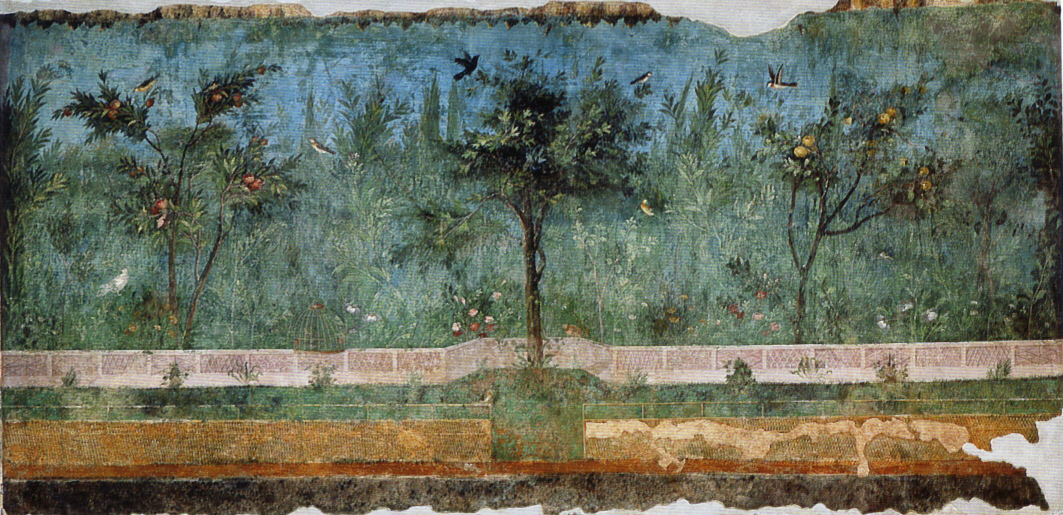
This Roman fresco from the first century BCE is in what's called the Second Style.  While the First Style created the illusion of an elegant marble wall, the Second Style was intended to create the illusion of a three-dimensional world and extend the space beyond the confines of the room. The Garden Fresco at the Villa of Livia is a prime example of the style.  This painting from a house on the Esquiline Hill, one of Rome's famed seven hills, is from a series depicting the travels of Odysseus.  Using painted columns to separate the scenes, the frescoes illustrate some episodes from Homer's Odyssey with great accuracy and detail.  The Laestrygonians, appearing in Book X of the Odyssey, were a race of cannibals who hurled rocks at Odysseus's fleet, destroying all but one of their ships and killing and eating several of his crew.  Odysseus's own ship was spared by hiding in a cove.  This fresco shows the Laestrygonians mostly with their backs to the viewer, currently hurling their stones to destroy the ships. I love to see the way ancient painters used space and color.  This anonymous painter imported a great deal of drama and action into this piece, conveying the turmoil of the scene and the chaos besieging the fleet. While it is difficult, or impossible, to know how the fresco looked two thousand years ago, the water remains a rich blue color, and the shading of the rocks, ships, and figures is clear.  Even now we can still get a sense of motion in the water and sky.  The figures themselves are skillfully posed to show their movement and activity.

Wednesday, August 5, 2015

Francis Picabia, La Source (The Spring)

Francis Picabia, La Source (The Spring), 1912
98 x 98 in.

Francis Picabia (1879-1953) was a major French avant-garde painter and poet.  Born in Paris to a French mother and a Spanish-Cuban diplomat, Picabia honed his artistic skill to finance his stamp collection; when he was fifteen he would create flawless copies to replace his father's Spanish paintings and then sell the originals without his father's knowledge.  He then studied at the École des Arts Decoratifs after being taken into the studio of leading history painter Fernand Cormon. Picabia's early work is heavily influenced by Impressionism, but people began to criticize his work for lack of originality.  He began incorporating Cubist elements into his work and soon became close friends with Marcel Duchamp and Guillaume Apollinaire.  Duchamp's influence can be immediately seen in Picabia's paintings.  We can also see the influence of Futurism and the extremes to which Picabia took his abstraction.  Picabia soon became a major pioneer of Dada, creating the Dadaist magazine 391.  Picabia's work continued to develop and he became a highly original and powerful artist.  He explored many genres and styles throughout his long career.  La Source (The Spring) is an extremely complex Cubist piece, demonstrating Picabia's skill in composition and controlled technique.  The limited palette gives the work a great deal of power and resonance, as the shapes and shades splinter and mirror each other so that the spatial relations of the painting become quite unclear.  Picabia offers the fracturing of Cubism with the delirium of Expressionism.  Its depth, both spatial and emotional, is elaborate and intricate, making it easy to become lost in these shapes black, red, and grey.

Monday, August 3, 2015

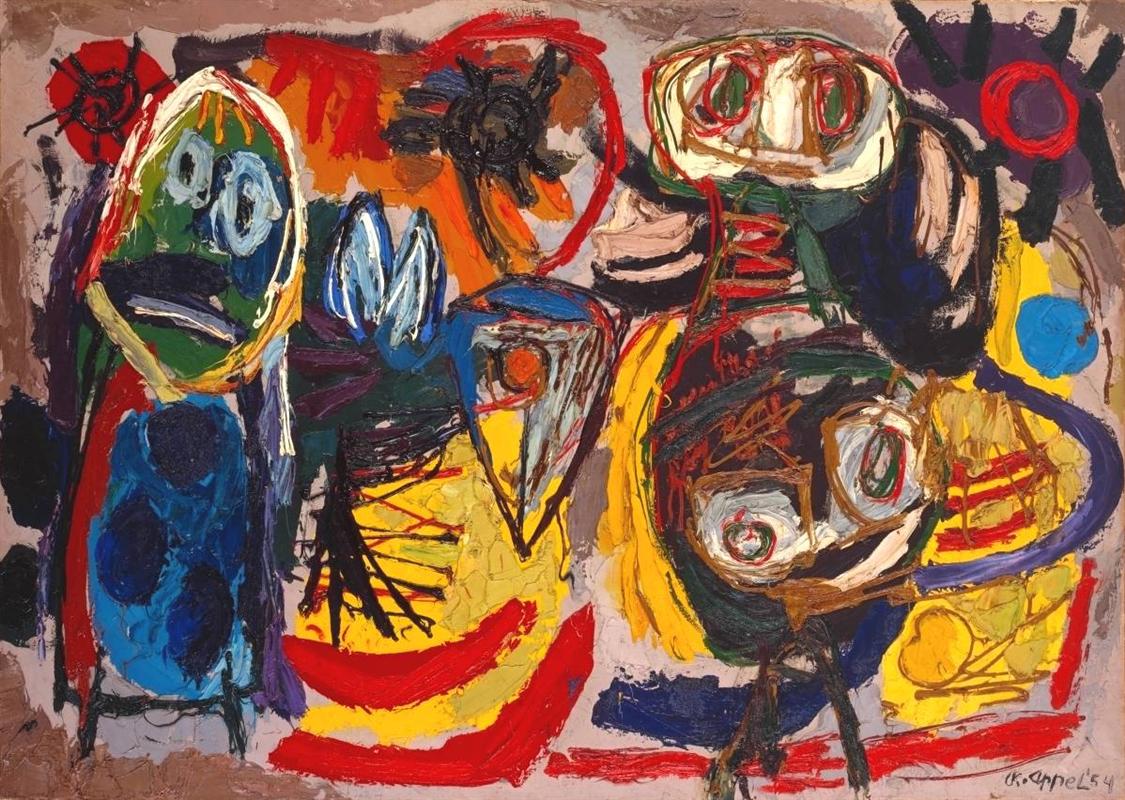
Karel Appel, Untitled

Karel Appel, Untitled, 1977

Karel Appel (1921-2006) was a major Dutch artist of the post-war period.  Appel produced paintings, sculpture, and drawings, as well as poetry.  Born in Amsterdam, he produced his first painting at fourteen.  His uncle, an amateur painter himself, gave young Karel and easel and paint set, as well as some introductory lessons.  Appel studied at Rijksakademie van Beeldende Kunsten in Amsterdam during the German occupation and had his first solo show in 1946.  In 1948 he cofounded the avant-garde group CoBrA (Copenhagen, Brussels, Amsterdam).  The group, and Appel in particular, often used a stylized version of children's drawings to explore (in part) dynamics of purity and corruption.  Appel's controversial mural Questioning Children (1949) prompted him to move to Paris where he developed his international reputation.  Some of his paintings have political content, such as Hiroshima Child (1958), but most retain some amount of figuration, whether a young girl, a crocodile, or a mountain landscape.  Appel did, however, work with pure abstraction in his drawings.  This untitled piece from 1977 is one of Appel's more abstract paintings; it is perhaps possible to make out some figures, but nothing is definite, especially without a title.  The painting is about its swirls of color and thick texture.  Appel was very engaged with the material quality of his paint, "slapping" it on the canvas with brush, palette knife, or by hand, and molding it to its desired shape and texture.  In this work we see the intermingling of the blue and purple, sometimes making it hard to see where one transitions into the other.  Yellow courses underneath while the black dances on top of the action, holding the composition together.

Sunday, August 2, 2015

Pierre Puvis de Chavannes, Young Girls on the Edge of the Sea

Pierre Puvis de Chavannes, Young Girls on the Edge of the Sea, 1879
24 x 18.1 in.

Pierre Puvis de Chavannes (1824-1898) was a prominent French Symbolist painter.  Born near Lyon as Pierre-Cécile Puvis, his father was a mining engineer who was descended from a noble family of Burgundy.  Throughout his life, Pierre identified strongly with the noble lineage of the Burgundians and later added the ancestral 'de Chavannes' to his name.  Puvis attended Amiens College in Paris, intending to follow his father's profession before a serious injury disrupted his plans.  He traveled to Italy as part of his convalescence and was transfixed by the art he saw. When he returned to Paris in 1846 he announced that he had decided to become a painter.  He was apprenticed to several painters, but found he preferred to work alone, taking anatomy classes at the Académie des Beaux Arts.  He had his first showing at the Salon in 1850, but it took many years for him to gain wide recognition.  Puvis is best known for large-scale murals; his work often has fantastical, pastoral, or allegorical themes, drawing on the inspiration of Classical art.  Puvis also did a number of religious paintings, the occasional portrait, scenes of peasant life, and some very interesting pieces that are difficult to classify.  Among his most famous pieces is the large mural The Sacred Grove Beloved by the Arts and Muses (1884-89).  Young Girls on the Edge of the Sea is in many ways characteristic of Puvis's work; it has an idyllic setting, soft colors, and Classical modeling of flesh and bodies.  However, there a less polished element to this painting that to my eye gives it its life.  Rather than the intensely sculptural appearance that Puvis's figures often have, this painting exhibits a greater degree of naturalness.  There is a certain roughness in the brushwork, particularly visible in the sky, that conveys engagement and emotionality.  The textures of the plants, ground, clouds, sea, hair, and flesh are all portrayed effectively and with great care.  In shaping these women's bodies, Puvis deviated somewhat from Classical poses, imbuing the figures with life and motion.

Saturday, August 1, 2015

Tsuchiya Koitsu, Long Spell of Rain

Tsuchiya Koitsu, Long Spell of Rain, 1930s

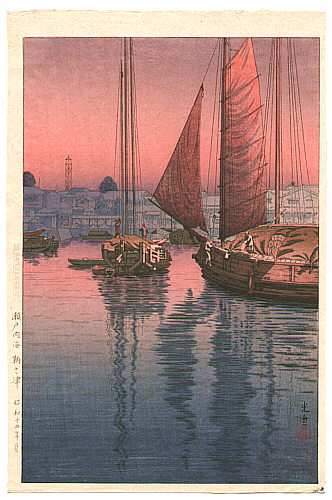
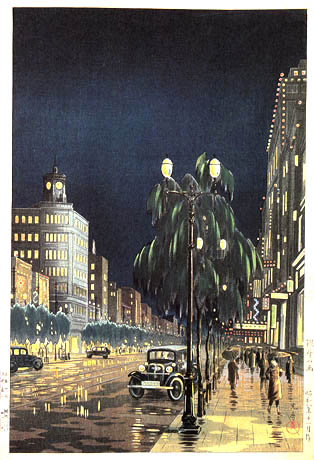
Tsuchiya Koitsu (1879-1949) was a well-known Japanese printmaker who specialized in woodblock (ukiyo-e).  He was a member of the shin hanga (new prints) movement that took place in the first half of the twentieth century.  Born in rural Japan, Koitsu went to Tokyo at age fifteen to apprentice with master printmaker Kiyochika Kobayashi.  Koitsu's first successful prints were depictions of the Sino-Japanese War of 1894-95.  Koitsu remained working in the studio of his master for nineteen years.  In 1931 he met the publisher Watanabe Shozaburo, and began to be published by him.  Watanabe published many prominent shin hanga artists and it through this distribution that Koitsu made a name for himself.  He drew on accepted shin hanga style, such as using intense lighting effects to convey the emotion of a scene.  Many of Koitsu's pieces are landscapes, and bear a very strong resemblance to centuries-old ukiyo-e.  However Koitsu is also frequently responding to modernity, such as in his cityscapes.  It is these two impulses that, to my eye, come together so strongly in Long Spell of Rain.  In many ways this resembles traditional Japanese woodblock, but its use of space and light also looks toward more modern art.  One of the most interesting elements is the flooded field that the two foremost figures (a mother and son?) are attempting to traverse; the floodwater shimmers in the warm, soft light in the exact same patterns as the blue water in the foreground, so that it almost looks like the water is being reflected in the air.  Meanwhile the foggy light in the sky recedes into dark inky blue.