Wednesday, August 5, 2015

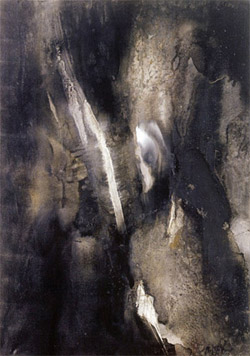
Francis Picabia, La Source (The Spring)

Francis Picabia, La Source (The Spring), 1912
98 x 98 in.

Francis Picabia (1879-1953) was a major French avant-garde painter and poet.  Born in Paris to a French mother and a Spanish-Cuban diplomat, Picabia honed his artistic skill to finance his stamp collection; when he was fifteen he would create flawless copies to replace his father's Spanish paintings and then sell the originals without his father's knowledge.  He then studied at the École des Arts Decoratifs after being taken into the studio of leading history painter Fernand Cormon. Picabia's early work is heavily influenced by Impressionism, but people began to criticize his work for lack of originality.  He began incorporating Cubist elements into his work and soon became close friends with Marcel Duchamp and Guillaume Apollinaire.  Duchamp's influence can be immediately seen in Picabia's paintings.  We can also see the influence of Futurism and the extremes to which Picabia took his abstraction.  Picabia soon became a major pioneer of Dada, creating the Dadaist magazine 391.  Picabia's work continued to develop and he became a highly original and powerful artist.  He explored many genres and styles throughout his long career.  La Source (The Spring) is an extremely complex Cubist piece, demonstrating Picabia's skill in composition and controlled technique.  The limited palette gives the work a great deal of power and resonance, as the shapes and shades splinter and mirror each other so that the spatial relations of the painting become quite unclear.  Picabia offers the fracturing of Cubism with the delirium of Expressionism.  Its depth, both spatial and emotional, is elaborate and intricate, making it easy to become lost in these shapes black, red, and grey.

Monday, August 3, 2015

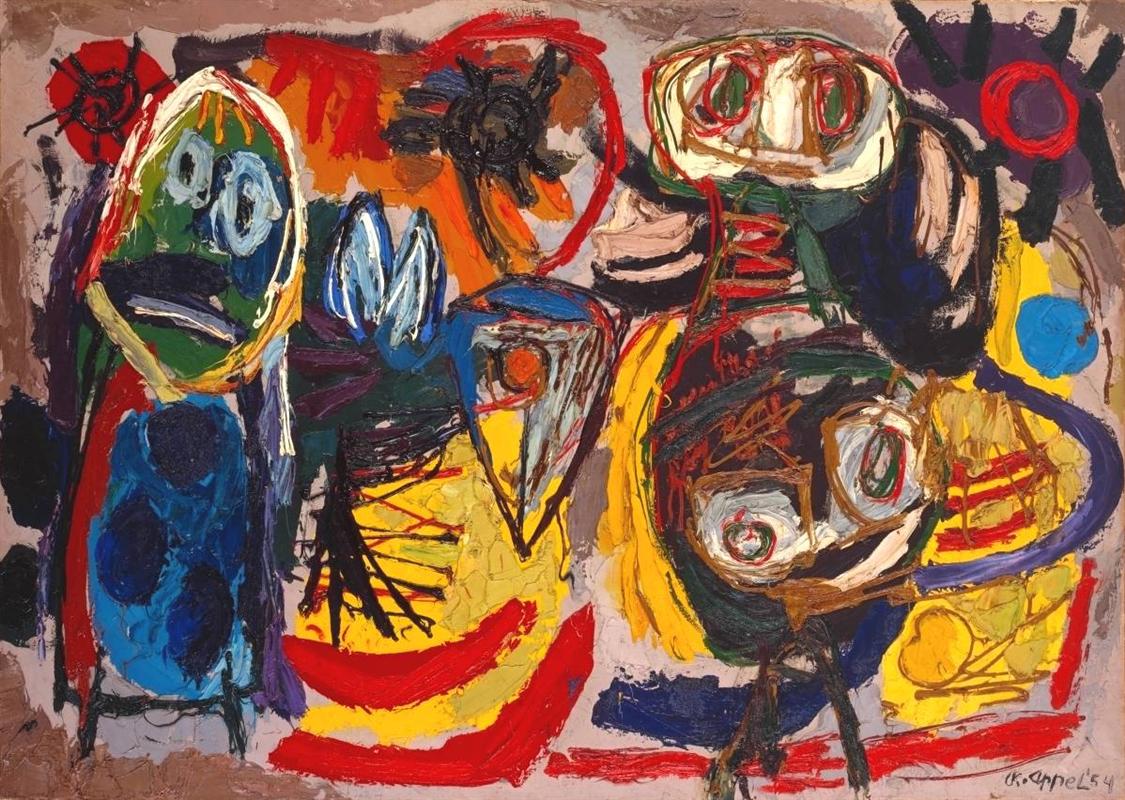
Karel Appel, Untitled

Karel Appel, Untitled, 1977

Karel Appel (1921-2006) was a major Dutch artist of the post-war period.  Appel produced paintings, sculpture, and drawings, as well as poetry.  Born in Amsterdam, he produced his first painting at fourteen.  His uncle, an amateur painter himself, gave young Karel and easel and paint set, as well as some introductory lessons.  Appel studied at Rijksakademie van Beeldende Kunsten in Amsterdam during the German occupation and had his first solo show in 1946.  In 1948 he cofounded the avant-garde group CoBrA (Copenhagen, Brussels, Amsterdam).  The group, and Appel in particular, often used a stylized version of children's drawings to explore (in part) dynamics of purity and corruption.  Appel's controversial mural Questioning Children (1949) prompted him to move to Paris where he developed his international reputation.  Some of his paintings have political content, such as Hiroshima Child (1958), but most retain some amount of figuration, whether a young girl, a crocodile, or a mountain landscape.  Appel did, however, work with pure abstraction in his drawings.  This untitled piece from 1977 is one of Appel's more abstract paintings; it is perhaps possible to make out some figures, but nothing is definite, especially without a title.  The painting is about its swirls of color and thick texture.  Appel was very engaged with the material quality of his paint, "slapping" it on the canvas with brush, palette knife, or by hand, and molding it to its desired shape and texture.  In this work we see the intermingling of the blue and purple, sometimes making it hard to see where one transitions into the other.  Yellow courses underneath while the black dances on top of the action, holding the composition together.

Sunday, August 2, 2015

Pierre Puvis de Chavannes, Young Girls on the Edge of the Sea

Pierre Puvis de Chavannes, Young Girls on the Edge of the Sea, 1879
24 x 18.1 in.

Pierre Puvis de Chavannes (1824-1898) was a prominent French Symbolist painter.  Born near Lyon as Pierre-Cécile Puvis, his father was a mining engineer who was descended from a noble family of Burgundy.  Throughout his life, Pierre identified strongly with the noble lineage of the Burgundians and later added the ancestral 'de Chavannes' to his name.  Puvis attended Amiens College in Paris, intending to follow his father's profession before a serious injury disrupted his plans.  He traveled to Italy as part of his convalescence and was transfixed by the art he saw. When he returned to Paris in 1846 he announced that he had decided to become a painter.  He was apprenticed to several painters, but found he preferred to work alone, taking anatomy classes at the Académie des Beaux Arts.  He had his first showing at the Salon in 1850, but it took many years for him to gain wide recognition.  Puvis is best known for large-scale murals; his work often has fantastical, pastoral, or allegorical themes, drawing on the inspiration of Classical art.  Puvis also did a number of religious paintings, the occasional portrait, scenes of peasant life, and some very interesting pieces that are difficult to classify.  Among his most famous pieces is the large mural The Sacred Grove Beloved by the Arts and Muses (1884-89).  Young Girls on the Edge of the Sea is in many ways characteristic of Puvis's work; it has an idyllic setting, soft colors, and Classical modeling of flesh and bodies.  However, there a less polished element to this painting that to my eye gives it its life.  Rather than the intensely sculptural appearance that Puvis's figures often have, this painting exhibits a greater degree of naturalness.  There is a certain roughness in the brushwork, particularly visible in the sky, that conveys engagement and emotionality.  The textures of the plants, ground, clouds, sea, hair, and flesh are all portrayed effectively and with great care.  In shaping these women's bodies, Puvis deviated somewhat from Classical poses, imbuing the figures with life and motion.

Saturday, August 1, 2015

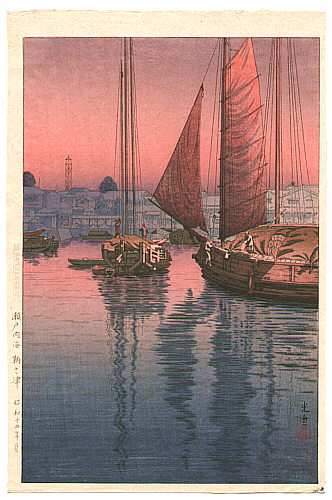
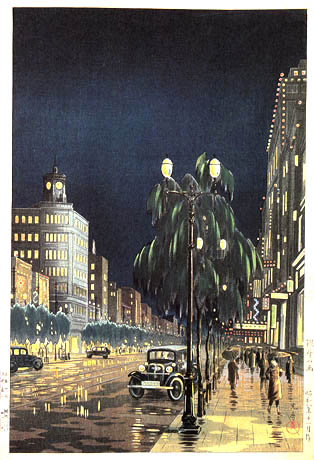
Tsuchiya Koitsu, Long Spell of Rain

Tsuchiya Koitsu, Long Spell of Rain, 1930s

Tsuchiya Koitsu (1879-1949) was a well-known Japanese printmaker who specialized in woodblock (ukiyo-e).  He was a member of the shin hanga (new prints) movement that took place in the first half of the twentieth century.  Born in rural Japan, Koitsu went to Tokyo at age fifteen to apprentice with master printmaker Kiyochika Kobayashi.  Koitsu's first successful prints were depictions of the Sino-Japanese War of 1894-95.  Koitsu remained working in the studio of his master for nineteen years.  In 1931 he met the publisher Watanabe Shozaburo, and began to be published by him.  Watanabe published many prominent shin hanga artists and it through this distribution that Koitsu made a name for himself.  He drew on accepted shin hanga style, such as using intense lighting effects to convey the emotion of a scene.  Many of Koitsu's pieces are landscapes, and bear a very strong resemblance to centuries-old ukiyo-e.  However Koitsu is also frequently responding to modernity, such as in his cityscapes.  It is these two impulses that, to my eye, come together so strongly in Long Spell of Rain.  In many ways this resembles traditional Japanese woodblock, but its use of space and light also looks toward more modern art.  One of the most interesting elements is the flooded field that the two foremost figures (a mother and son?) are attempting to traverse; the floodwater shimmers in the warm, soft light in the exact same patterns as the blue water in the foreground, so that it almost looks like the water is being reflected in the air.  Meanwhile the foggy light in the sky recedes into dark inky blue.

Friday, July 31, 2015

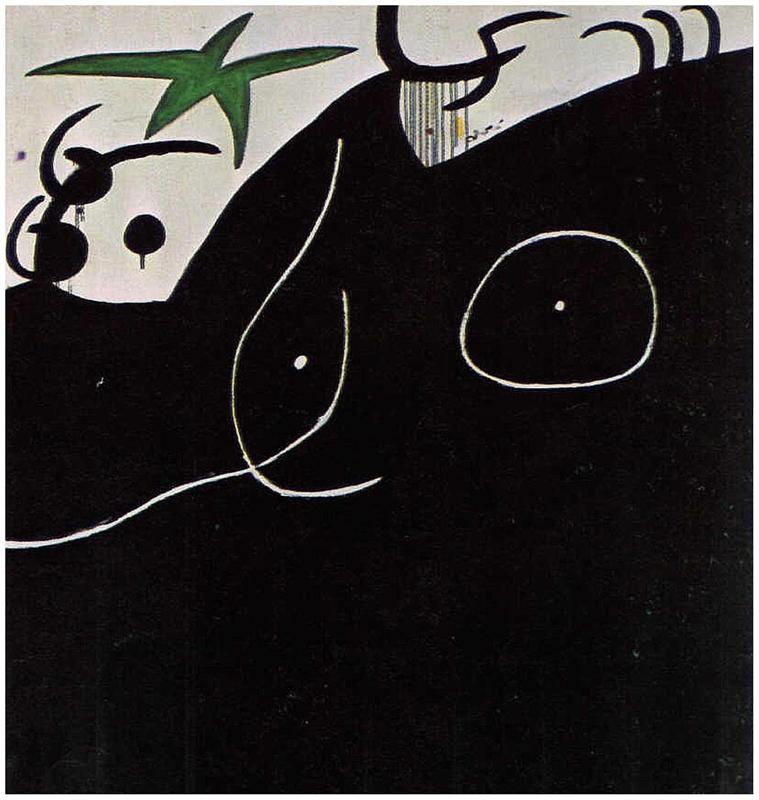
Joan Miró, People at Night, Guided by the Phosphorescent Tracks of Snails

Joan Miró, People at Night, Guided by the Phosphorescent Tracks of Snails, 1940
14.94 x 18 in.

Joan Miró (1893-1983) was a major Spanish/Catalan artist, an important figure in the development of modern art.  Born in Barcelona, he began drawing lessons at age seven.  He studied at the fine art academy at La Llotja and then at the Cercle Artistic de Sant Lluc.  Miró had his first solo show in 1918, but his work was ridiculed.  His early work shows a mixture of influences, particularly traditional art and Fauvism.  After the failure of his first show, Miró moved to Paris where he hoped the artistic community at Montparnasse would be more receptive. Influenced by Cubism and Surrealism, he began to develop his own aesthetic.  His style really took form in the mid-twenties, when his particular use of color and geometry produced works of great complexity and originality.  Miró's two most famous pieces are from this period: Dancer (1925) and the highly symbolic Birth of the World (1925).  While he utilized similar elements for the rest of his career, his late work is quite diverse and striking.  The painting I have featured is from a series of small paintings generally known as Constellations.  There are twenty-three of them, each as complex and beautiful as the last.  People at Night, Guided by the Phosphorescent Tracks of Snails is unusual in the series for its blue background, which gives the appearance of nighttime.  These figures and shapes swirl around each other in the night sky. Miró tells us that they are guided by the phosphorescent tracks of snails, the spheres of light along some of the lines.  There is indeed a phosphorescence in this piece, a luminosity that draws me to it and makes me want to gaze into the inky blue and follow the lines in stark black and red.

Thursday, July 30, 2015

Paul Jenkins, The Archer

Paul Jenkins, The Archer, 1955
51 x 31 in.

Paul Jenkins (1923-2012) was an American abstract painter.  Born in Kansas City, Missouri, as a boy Jenkins met Frank Lloyd Wright when he was hired by his uncle to rebuild a church.  The great architect encouraged the young Jenkins to pursue agriculture rather than art.  His uncle then encouraged Jenkins to visit Thomas Hart Benton, who encouraged Jenkins in his aspirations. After serving in the Navy, Jenkins moved to New York in 1948 and studied at the Art Students League.  Around this time, Jenkins met leaders of the first generation of Abstract Expressionists—Mark Rothko, Lee Krasner, Jackson Pollock, and Barnett Newman.  In 1953 he traveled to Europe and eventually settled in Paris, divinding his time between Paris and New York.  His first solo exhibition was held in Paris in 1954.  His first important sales were Divining Rod (1956), purchased by the Whitney Museum, and Peggy Guggenheim's purchase of Osage (1956). Although he always worked in pure abstraction, Jenkins's paintings do evoke natural formations like mountains, waves, amber, or marble.  Beginning around 1960, Jenkins moved away from oils toward acrylics, creating pieces that appear as veils of color.  Although they look like staining, they were produced with pouring and spreading with an ivory knife.  He frequently used the word phenomena in his titles, giving his work an air of the supernatural.  Later works like Phenomena Astral Tundra (1986), Distance Finding Mozart (1992), and Phenomena Wind Arch (2009) use a similar technique but continue to explore its diverse possibilities.  The Archer is one of Jenkins's earliest pieces, demonstrating the rich texture and dense composition that marks his early work. There is possibly a vague human figure with a bow drawn suggested in the black that forms something of a background, but mostly the painting is an explosion of color with all sorts of shapes and sights available to the viewer's interpretation.  To me there is ecstasy here, with the possibility of being overwhelmed by the intensity of these colors.