Friday, October 31, 2014

Francisco Goya, Witches' Flight

Francisco Goya, Witches' Flight, 1797-8
17.125"x12"

Halloween Part II.  I mentioned this painting in yesterday's post as part of Musée d'Orsay's exhibit, Dark Romanticism: From Goya to Max Ernst, but I decided it was worth another look.  Depictions of witches have along tradition in western art, such as Dürer's depictions and Hans Baldung's more gruesome Witches' Sabbath, Three Witches, and Standing Witch with Monster.  These prints all date from the late fifteenth or early sixteenth century, and they were in response to the publication of the Malleus Maleficarum by Heinrich Kramer, generally held responsible for the anti-witch fury that came to grip Europe.  Goya's piece was done three centuries later and presents a very different view.  It is more fantastical and it does not vilify the witches in the same way.  Nevertheless, the painting is extremely eerie, with its floating witches and lack of setting or context.  The figure lying prone among the three witches is of completely unclear status, but seems to be the subject of some ritual.  The figure on the ground attempt to escape the scene above, but the one still standing (with the sheet over his face) also seems to occupy the role of a promoter, drawing viewers to the spectacle taking place above him.  Goya's skill with chiaroscuro (and with extremely creepy subject matter) is on full display here.  He creates a painting that is very unsettling, yet also very compelling that viewer cannot quite look away from.

Thursday, October 30, 2014

William Bouguereau, Dante and Virgil

William Bouguereau, Dante and Virgil, 1850
110.63"x88.53"

Happy Halloween!  I've already written about Botticelli's depiction of Dante's Hell, but the story isn't why I wanted to discuss this painting.  I just thought it was creepy, with its vampiric and demonic elements.  William Bouguereau (1825-1905) is mostly known for his traditional paintings of classical themes––nude women, cherubs, mythic scenes, nymphs––that are quite well done and generally pleasant and agreeable.  This painting demonstrates that he also had a talent for high drama.  The scene is based on a minor episode from Inferno where Dante and Virgil witness a fight between two damned souls, and one gets bitten on the neck.  Bouguereau interpreted the incident with this extremely sexual, homoerotic cast.  Bouguereau's skill is evident, showing great realism in the contortion of the men's muscles, and he uses vivid color and excellent shading throughout the canvas.  The image of the attacker as a vampire is difficult to ignore; even his ravenous eyes and burning red hair contribute to that impression.  The overall creepiness is enhanced by the pile of bodies engaged in orgiastic suffering on the right and the demon leering above the whole scene.

I saw this painting in a fascinating exhibition at Musée d'Orsay entitle Angel of the Bizarre: Dark Romanticism from Goya to Max Ernst.  The exhibition explored the romantic fascination with the dark and gothic over the course of about a century in a half.  Among the other pieces included there were Henri Fuseli's The Nightmare (1781) and Sin Pursued by Death (1797), Edvard Munch's Vampire (1895), Francisco Goya's Witches' Flight (1798), Louis Boulanger's Les Fantômes (1829), Franz Stuck's La Péché (1893), Serafino Macchiati's The Visionary  (1904), Gustave Moreau's Victim (which was quite unsettling in situ), and Carlos Schwabe's Death of the Gravedigger (1895).  It was a fantastic exhibition and had so many perfect Halloween paintings that I couldn't resist sharing them.

Wednesday, October 29, 2014

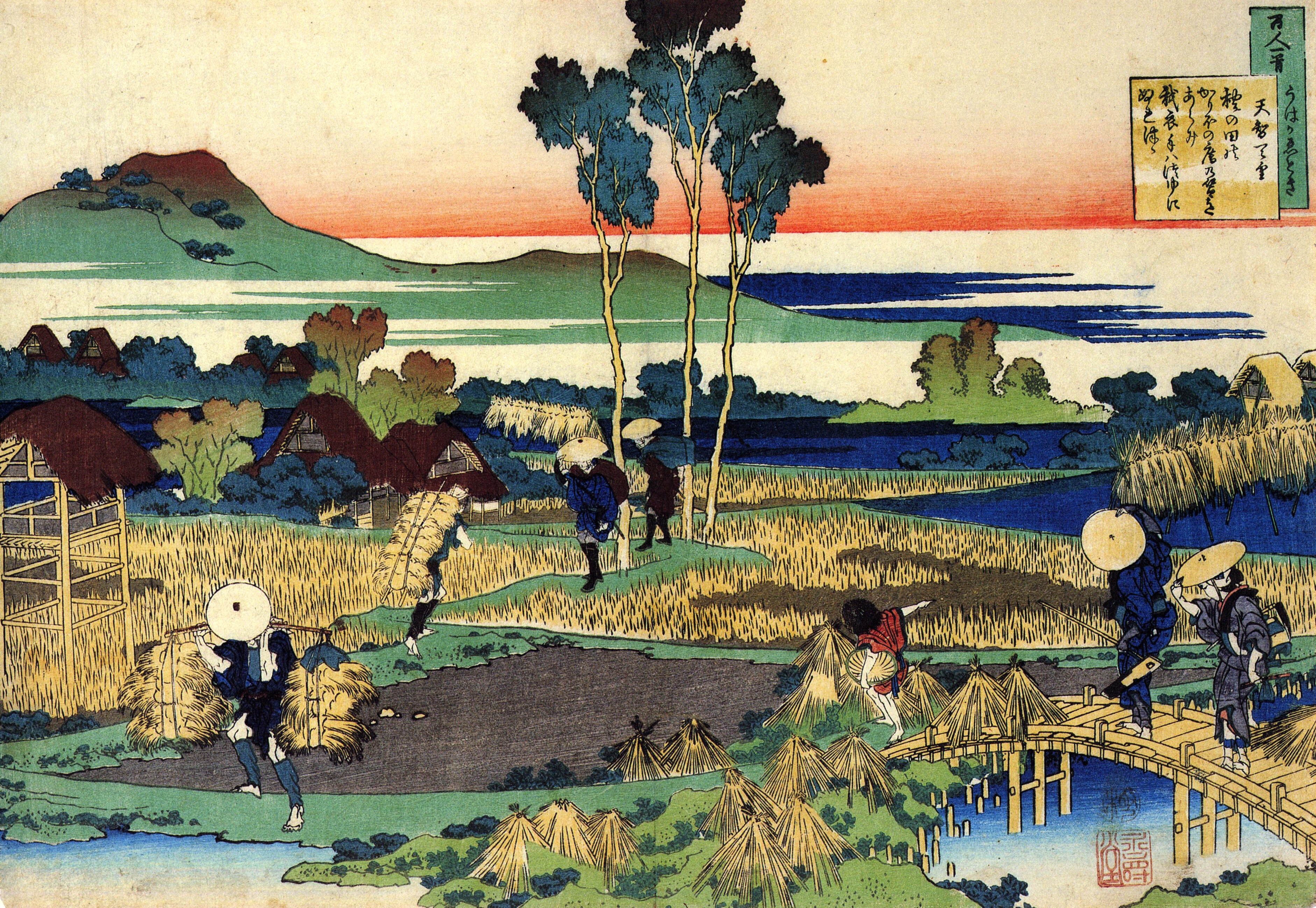
Hokusai, One Hundred Poets--First Print


Katsushika Hokusai (1760-1849) was a Japanese painter and printmaker, one of the greatest of the Edo period printmakers, along with Ando Hiroshige.  Hokusai is best known for his woodblock series Thirty-six Views of Mount Fuji, of which The Great Wave off Kanagawa has become most famous.  This piece is from Hokusai's last major series, "One Hundred Poets, One Poem Each As Explained by the Old Nurse."  The series is an exploration of the canonical Japanese poetry anthology, Ogura Hyakunin Isshu, compiled in the thirteenth century.  Hokusai did not create literal representations of the poems, but rather images related to them that express his own personal sense of the poem and its relation to his experiences.  This is the first print in the series, accompanying the first poem in the book:
       
      Because of the coarseness of the rush-mat
      Of the hut of temporary-hut
      Of the rice of autumn
      As far as concerns my sleeves
      They are becoming wet with dew.
                               –Emperor Tenji

Although Emperor Tenji is not present in the piece, Hokusai depicted the type of rice field alluded to in the poem.  He shows the farmers at work, the water that flows through the field, and the hut that the poem describes.  Although the figures' faces are mostly obscured, their presence is not diminished.  Their agricultural labor and the reality of their rural peasant lives comes through quite strongly.  Among Hokusai's greatest talents was his ability to portray depth.  The water stretches off into the distance, and its spatial presence is made clear with a type of atmospheric perspective.  The mountains in the background are surrounded by mist that helps situate them in the distance.  The sky is also stunningly rendered, with the blue that reflects the water and the red-orange of the sunset that signals the end of the workday.  The reflection element is also mirrored in the water at the very fore of the image; the bridge disappears into nothingness and the white of the misty sky appears again.

Tuesday, October 28, 2014

Gustave Caillebotte, The Floor Scrapers

Gustave Caillebotte, The Floor Scrapers, 1875
40.2"x57.7"

Gustave Caillebotte (1848-1894) was a French painter who was a member of the Impressionist group, but painted in a very different style.  Caillebotte worked in a more realistic style, with crisper lines and more precise brushwork.  He was very interested in photography and continually depicted the modernization of Paris and everyday Parisian life.  The Floor Scrapers is one of Caillebotte's best known paintings, along with 1877's Paris Street, Rainy Day.  I was fortunate enough to see this painting in person at Musée d'Orsay last year and the impact is quite remarkable.  What I remember most is the richness of the color.  The wood floor was such a vivid color brown that it seemed to radiate off the canvas, and the sunlight streaming in illuminated everything with such bright intensity.  Caillebotte's draughtsmanship is also impressive; the wood shavings that have been removed curl and pile with focused detail and the men's working musculature is faithfully sculpted.  The image I have included does not entirely do justice to these elements, but the coloration was the closest reproduction I could find.  The painting is a beautiful rendering of this earthy scene, and Caillebotte portrayed it with an intensity and focus that reveals the artist's great interest in such working class scenes.

Monday, October 27, 2014

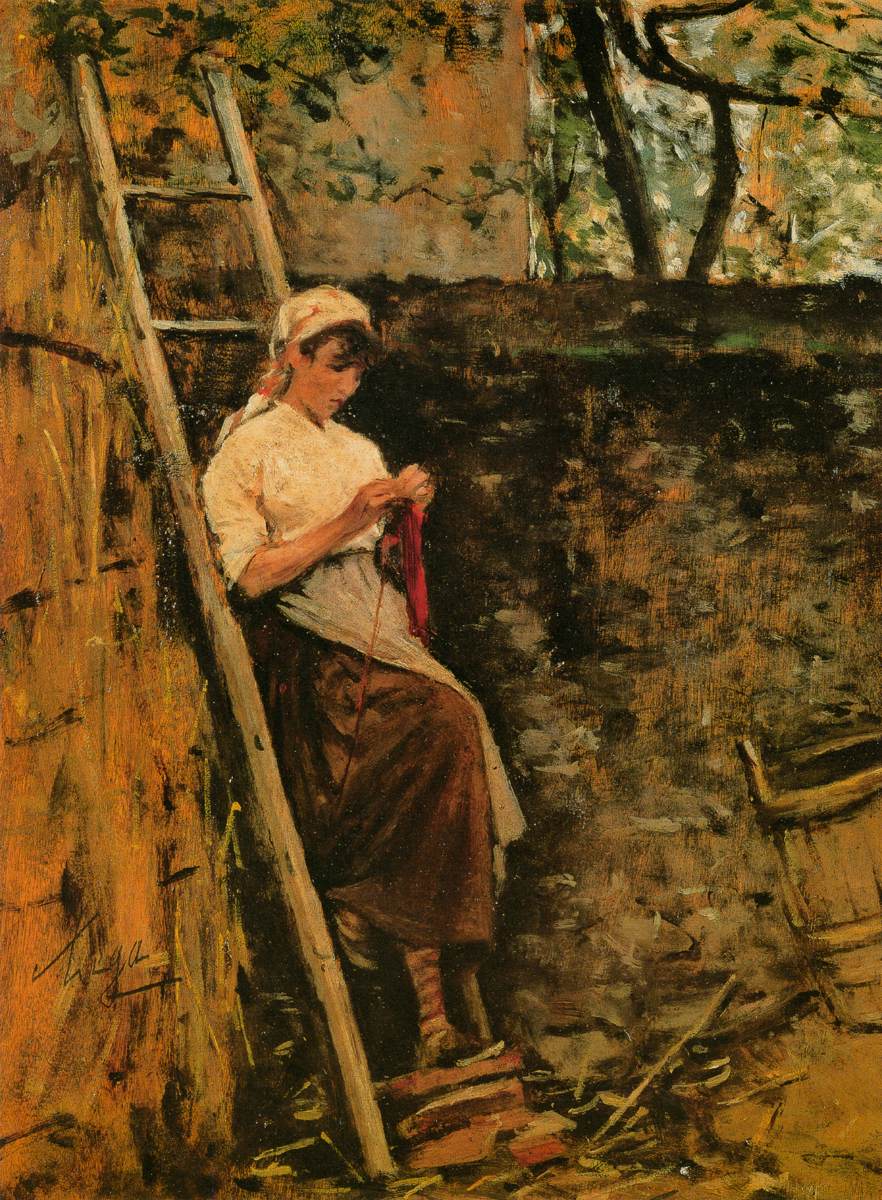
Silvestro Lega, Country Girl Leaning Against a Ladder

Silvestro Lega, Country Girl Leaning Against a Ladder, c1895
15x11.4 in.

Silvestro Lega (1826-1895) was a prominent Italian painter.  He was a Realist, and also a leading member of the Macchiaioli, often considered the Italian counterpart to Impressionism.  Lega's work exhibits qualities associated with both Impressionism and Realism, as do the Macchiaioli in general.  The Macchiaioli movement mirrored Impressionism in its emphasis on painting outdoors, on accurate portrayals of light, and the free brushwork and paint handling that conveys the subjective reality of the artist.  However much of the subject matter and themes of Macchiaioli painting followed the values ascribed to Realism in France.  Many of these paintings depict Italian peasant scenes and discuss the realities of these people's lives.  In this way, they often contained political ideas and Lega was involved in Giuseppe Mazzini's movement to unify Italy.  Country Girl Leaning Against a Ladder is a perfect example of all these ideas.  The painting beautifully communicates the reality of the scene, but the loose brushwork gives a very personal and inviting feeling.  Lega also successfully communicates the heat of this hazy afternoon and the laboriousness of this girl's daily life.  Lega utilizes a narrow palette, but skillfully blends the browns and greens to make the whole canvas engaging.  The girl's skin stands out brighter than her surroundings, and her white garments are also noticeable, but the red of the girl's knitting is the most striking.  Even without sufficient detail to make out what she is working on (A sock? A scarf?), this small splash of color completes the piece to create a thoroughly arresting painting.

Sunday, October 26, 2014

Tim O'Connor, Untitled


My apologies for the poor quality of today's image, but I took it myself at an art show I went to tonight.  The show was by my friend Tim O'Connor, a 25-year-old working artist on Long Island, a native of Port Jefferson.  In addition to painting, Tim does drawing and conceptual/installation art.  I love Tim's painting and this piece is very intriguing.  Tim told me that the painting is about the inner child.  The dragon is a protective force, coiled around the vulnerable parts of ourselves.  Tim uses variegated color to create contrasts, rather than utilizing shading, and I think this technique creates very striking effects.  In this painting, the warm blue of the dragon's scales contrasts with the red and yellow that surround it and create a surprising sense of unity in the piece.  Some common themes in Tim's work are explorations of the mystical parts of ourselves, and the enduring role nature plays in our psyches and the importance of that connection.  Both of these themes are present in this painting, which has representations of plants and feathers, as well as the manifestation of a mystical protective force.  Along the bottom left of the canvas, another dragon appears in outline with the word freedom on its back, a drive that our inner child yearns for and our inner dragon can help us achieve.

Here are two more of Tim's pieces:

Saturday, October 25, 2014

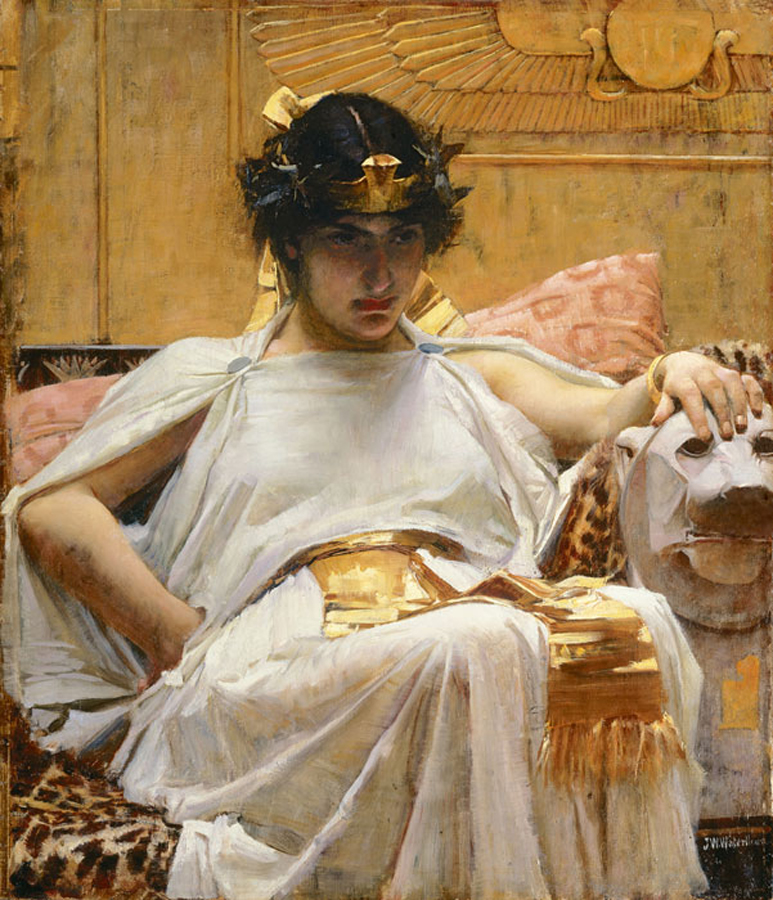
John William Waterhouse, Cleopatra

John William Waterhouse, Cleopatra, 1888
22.4x25.7 in.

John William Waterhouse (1849-1917) was an English painter who worked in the Pre-Raphaelite style, although he worked decades after the movement was formed.  The style was still popular when Waterhouse worked, but he was considered somewhat old-fashioned, despite his success.  Waterhouse was best known for his scenes of Greek mythology and Arthurian legend, but he also did a number of paintings of Roman history.  This piece is a fascinating portrayal of Cleopatra.  Always a woman of mystery in the Western imagination, it has never been completely agreed upon whether Cleopatra was more alluring due to her beauty or her brilliance.  Waterhouse has managed to completely intertwine the two traits.  He depicts a woman of great intensity and power, and her intelligence and sexuality are both on display here.  Cleopatra reclines among her fineries, revealing little skin, but displaying her body seductively nonetheless.  However the center of the painting is undoubtedly her eyes.  The energy that exudes from Cleopatra's expression is palpable; she almost looks aggressive, yet entirely captivating.  It is difficult to look away from her face.  Waterhouse's handling of paint is quite diverse and effective.  He carefully shaded Cleopatra's skin and delicately rendered her hair, but uses rough, broad strokes on the wall and belt, successfully conveying the texture of the gold.  There is also duality in Cleopatra's pose–one hand rests on the lion statue while the other bends at her waist, looking impatient and agitated, lending another dimension to her expression.  Although Cleopatra's thoughts and the meaning of her countenance are hard to discern, she is clearly (and rightly) shown as a woman of great force and authority.  What has ultimately endured over more than two thousand years is the immense power and allure of the last Pharaoh.